Free Pilates Common Mistakes & Corrections Guide: 34 Classical Mat Exercises
A visual correction guide for spotting common mistakes in the 34 classical Pilates mat exercises.
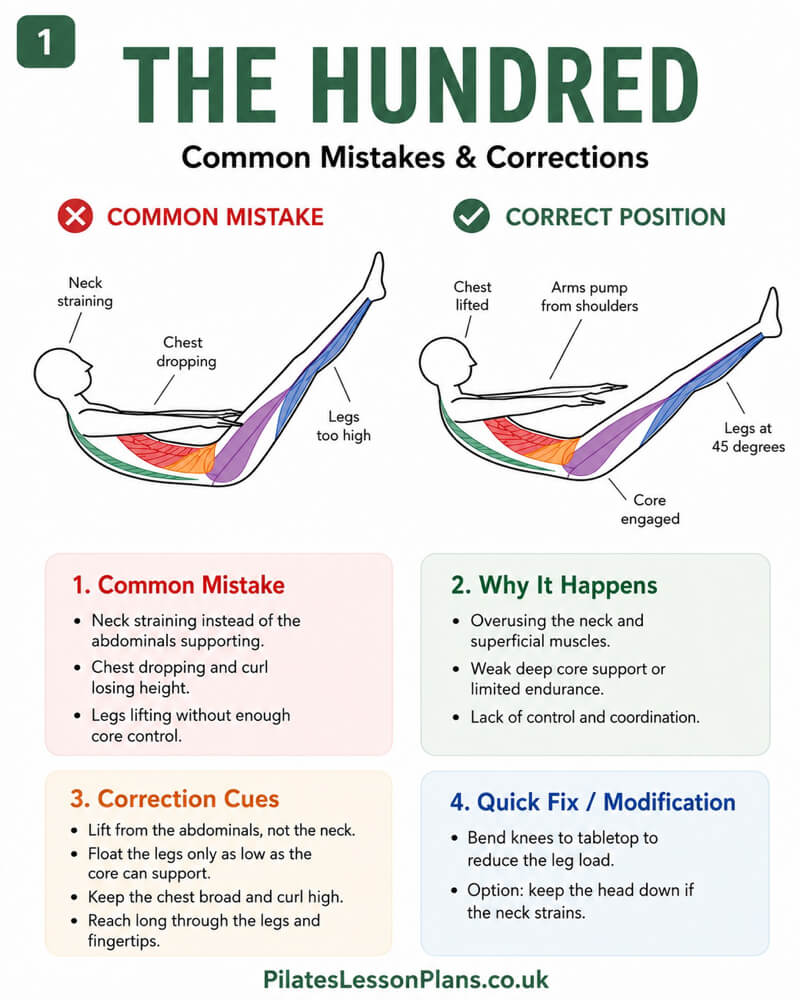
The Hundred Pilates Mistakes And Corrections Card
Welcome to my free Pilates Common Mistakes & Corrections Guide.
This guide is for Pilates teachers, trainee teachers, teacher trainers, and serious students who want to get better at spotting what often goes wrong in the 34 classical Pilates mat exercises — and, more importantly, what to cue instead.
When I’m not updating the Online Pilates Lesson Planner, creating Pilates Card Decks, or having a very serious conversation with a Pilates illustration that refuses to behave, I’m usually making visual teaching resources to help Pilates teachers feel more confident in class.
This free guide gives you a preview of the Pilates Common Mistakes & Corrections Card Deck: a set of 34 visual correction cards covering the full classical Pilates mat sequence.
Each exercise below includes a visual card, a common mistake, why it happens, correction cues, and a quick fix or modification.
“I can see something is going wrong in this exercise… but what exactly should I cue?”
That is the moment this guide is designed for.
Because in real Pilates classes, students do not always arrive in a perfect textbook shape. Shoulders creep up. Ribs flare. Necks join in too enthusiastically. Pelvises wobble. Legs go rogue. And sometimes a Roll Up becomes a dramatic negotiation between gravity, hamstrings, and hope.
The aim of this guide is to make those teaching moments easier to understand.
Instead of just thinking, “That looks a bit wonky,” you can start to recognise common patterns: using momentum, dumping weight into the neck, losing abdominal support, collapsing through the shoulders, gripping the hip flexors, flaring the ribs, or forgetting that the pelvis is supposed to be part of the team.
This is not meant to be a dry textbook.
It’s more like the visual correction notebook I wish I’d had during Pilates teacher training: practical enough to use in class, simple enough to understand quickly, and just silly enough to stop Jack Knife taking itself too seriously.
Want the full App-like PDF card deck?
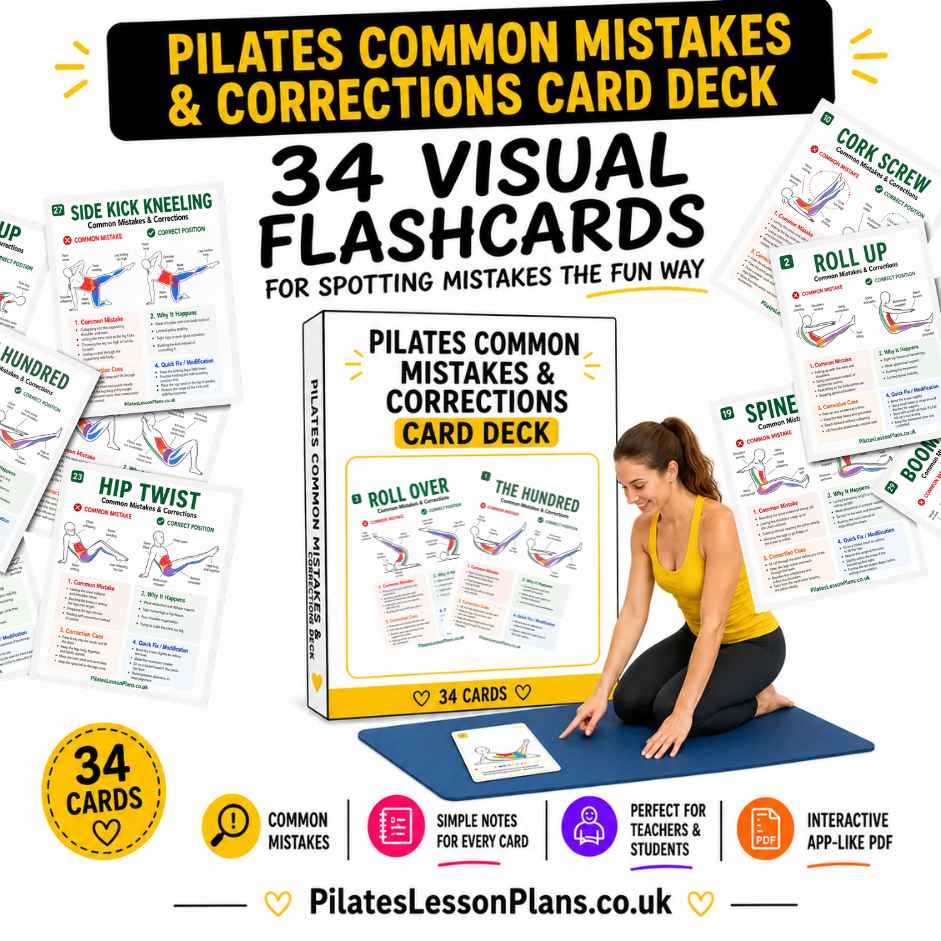
Common Mistakes & Corrections Card Deck
You can happily enjoy the free guide below. But if you would rather have all 34 mistake-and-correction cards gathered into one neat interactive PDF, plus printable cards and individual JPG/PNG files, the full deck is ready and waiting.
How It Works
Below, you’ll find all 34 classical Pilates mat exercises, each presented as a visual mistake-and-correction card.
Each section includes:
-
Common Mistake: The thing that often goes wrong in the exercise.
-
Why It Happens: The likely reason behind the mistake.
-
Correction Cues: Simple teaching prompts you can use straight away.
-
Quick Fix / Modification: A practical way to make the exercise more achievable.
You can read the guide from start to finish, jump to a specific exercise, or use the theme index below to explore the most common teaching problems.
Think of this as a visual troubleshooting guide for classical Pilates matwork. Not because your students are doing anything “wrong” in a dramatic, doom-filled way — but because small changes in alignment, control, breath, and support can make a big difference to how the exercise feels and functions.
The full Pilates Common Mistakes & Corrections Card Deck gives you the same information in a cleaner, printable, app-like PDF format, so you can study it on your phone, tablet, laptop, or print the cards as charts/posters for your studio.
Common Pilates Mistakes By Theme
Use this section when you want to explore the classical mat exercises by the type of mistake or correction issue you’re seeing in class.
It’s especially helpful when you’re planning a Pilates lesson, preparing for teacher training, or trying to work out why a pelvis has suddenly developed the confidence of a shopping trolley with one wonky wheel.
Each link takes you straight to the relevant mistake-and-correction section below, so you can quickly find the exercises connected to that teaching theme.
Neck & Shoulder Tension
For exercises where students may strain the neck, collapse into the shoulders, grip the upper body, or let the head lead the movement like it has been promoted to class captain.
Exercises: The Hundred, One Leg Stretch, Double Leg Stretch, Neck Pull, Scissors, Jack Knife, Leg Pull Front, Push Up.
Loss Of Core Control
For exercises where the abdominals need to support the spine, ribs, pelvis, and legs — preferably before everything starts waving at different parts of the room.
Exercises: The Hundred, Roll Up, Roll Over, One Leg Stretch, Double Leg Stretch, Teaser, Hip Twist, Boomerang, Control Balance.
Using Momentum Instead Of Control
For exercises where students may swing, throw, launch, bounce, or generally use enthusiasm where control would have been a better life choice.
Exercises: Roll Up, Roll Over, Rolling Back, Rocker With Open Legs, Seal, Crab, Jack Knife, Boomerang.
Pelvis Wobbling & Hip Control
For exercises where the legs move and the pelvis is supposed to remain calm, organised, and not immediately join the performance.
Exercises: One Leg Circle, Cork Screw, Side Kick, Hip Twist, Shoulder Bridge, Side Kick Kneeling, Control Balance.
Poor Spinal Articulation
For exercises where the spine needs to roll, curl, peel, lengthen, or articulate — rather than move as one large plank with opinions.
Exercises: Roll Up, Roll Over, Rolling Back, Spine Stretch, Neck Pull, Seal, Crab, Jack Knife.
Weight Into Neck Or Shoulders
For inverted or shoulder-supported exercises where the upper back needs to support the position without the neck being given an unpaid management role.
Exercises: Roll Over, Scissors, Bicycle, Jack Knife, Control Balance.
Collapsing In Weight-Bearing Exercises
For exercises where the shoulders, wrists, arms, ribs, pelvis, and legs all have to organise themselves under load without becoming a human hammock.
Exercises: Leg Pull Front, Leg Pull, Side Bend, Push Up, Side Kick Kneeling.
Rib Flaring & Lower Back Overworking
For exercises where the ribs may pop forward, the lower back may grip, or the body tries to fake extension by creating one very enthusiastic lumbar curve.
Exercises: Double Leg Stretch, Swan Dive, One Leg Kick, Double Leg Kick, Swimming, Shoulder Bridge, Rocking.
Exercise Index
Jump straight to an exercise:
Here are the 34 Pilates Common Mistakes & Corrections cards…
1. The Hundred
Pilates Common Mistake & Correction Card
Click the image to enlarge it
The Hundred Pilates Common Mistakes & Corrections Card.
Common Mistake
The most common mistake in The Hundred is losing abdominal support while trying to keep the head, shoulders, arms, and legs lifted. The lower back may arch away from the mat, the shoulders may creep towards the ears, and the neck may start doing far too much work.
Why It Happens
This usually happens when the legs are too low, the curl is too high, or the student is trying to “survive” the exercise rather than organise it. The abdominals fatigue, the ribs flare, and the neck decides to help like an overenthusiastic assistant manager.
Correction Cues
Cue the student to draw the ribs down, keep the back of the waist heavy, soften the jaw, widen the collarbones, and pump the arms from a steady centre. Lift the legs higher if the lower back is arching.
Quick Fix / Modification
Bend the knees into tabletop, keep the head down, or reduce the number of arm pumps. The goal is organised breathing and core control, not a tiny neck-led panic concert.
2. Roll Up
Pilates Common Mistake & Correction Card
Click the image to enlarge it
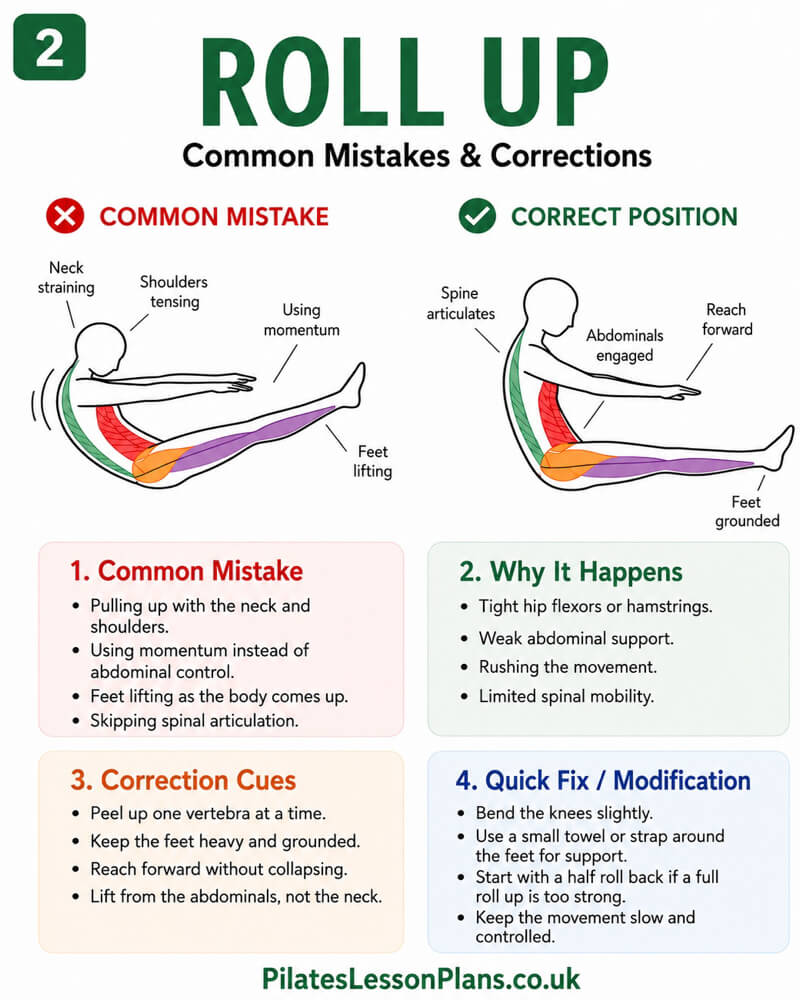
Roll Up Pilates Common Mistakes & Corrections Card.
Common Mistake
In Roll Up, students often throw the arms forward, use momentum to sit up, grip the hip flexors, or skip over the sticky parts of the spine. Instead of rolling smoothly, the movement becomes a slightly dramatic sit-up wearing a Pilates hat.
Why It Happens
This often happens because the abdominals are not yet strong enough to control the full range, the spine lacks segmental mobility, or the hamstrings and lower back are limiting the forward fold.
Correction Cues
Cue the student to reach through the heels, soften the ribs, peel the spine from the mat one segment at a time, and keep the arms reaching forward without flinging them. Ask them to move more slowly through the difficult section, not faster.
Quick Fix / Modification
Bend the knees, hold behind the thighs, use a small towel under the head, or practise half roll backs first. If the body is launching itself like a startled deckchair, make the range smaller.
Get the full Pilates Common Mistakes & Corrections Card Deck here.
3. Roll Over
Pilates Common Mistake & Correction Card
Click the image to enlarge it
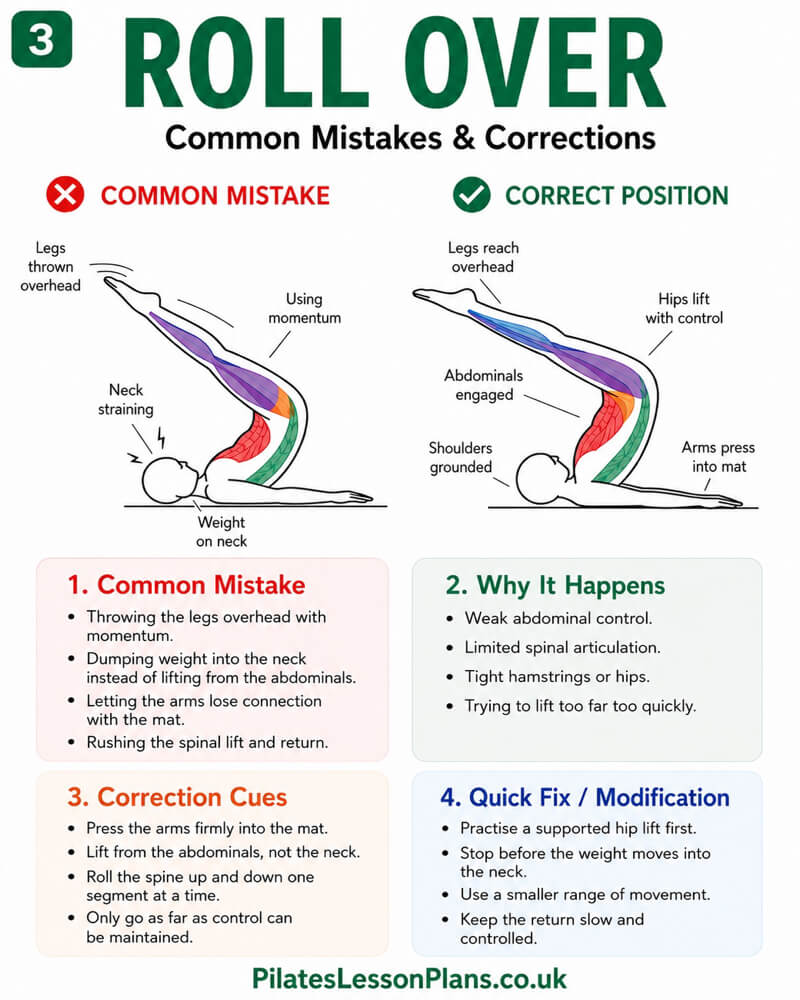
Roll Over Pilates Common Mistakes & Corrections Card.
Common Mistake
In Roll Over, students often throw the legs overhead, dump weight into the neck, lose control through the arms, or collapse through the spine on the way down.
Why It Happens
This usually happens when the student relies on leg momentum rather than abdominal control. Tight hamstrings, limited spinal articulation, or a desire to “get the toes to the floor at all costs” can also turn Roll Over into a neck-based expedition.
Correction Cues
Cue the arms to press down into the mat, the abdominals to lift the pelvis, and the legs to reach long rather than swing. Keep the weight on the shoulders and upper back, never on the neck.
Quick Fix / Modification
Practise pelvic curls, supported rollovers, or smaller overhead movements. Stop before the student loses neck safety or spinal control. There is no prize for forcing the feet to the floor while the neck writes a complaint letter.
Get the full Pilates Common Mistakes & Corrections Card Deck here.
4. One Leg Circle
Pilates Common Mistake & Correction Card
Click the image to enlarge it
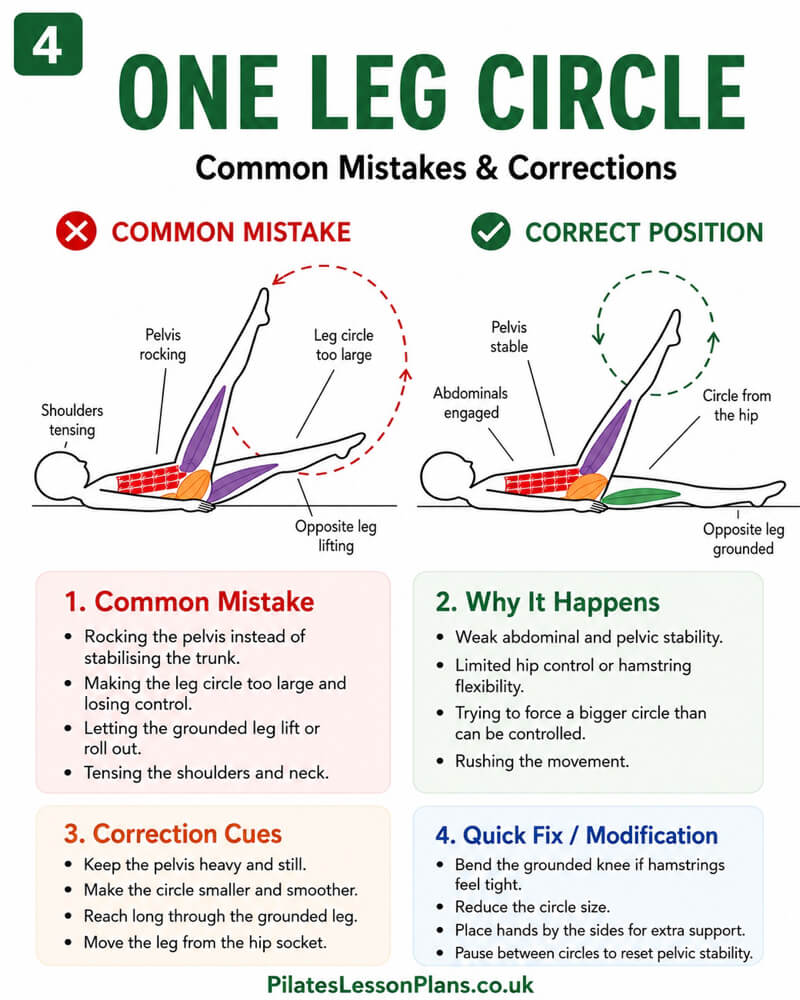
One Leg Circle Pilates Common Mistakes & Corrections Card.
Common Mistake
In One Leg Circle, the moving leg often pulls the pelvis from side to side. The circle becomes too large, the ribs pop up, and the supposedly stable body starts joining in like it has been invited to a tiny hula-hoop competition.
Why It Happens
This usually happens because the circle is too big for the student’s current hip mobility and pelvic control. The body borrows movement from the lower back, ribs, or pelvis instead of keeping the movement at the hip joint.
Correction Cues
Cue the pelvis to stay heavy and level, the ribs to soften, and the circle to come from the hip socket. Ask for a smaller circle with more control, rather than a larger circle with a travelling pelvis.
Quick Fix / Modification
Bend the supporting knee, make the circle smaller, or bend the moving knee slightly. The student can also place their hands on the front hip bones to feel whether the pelvis is staying quiet.
Get the full Pilates Common Mistakes & Corrections Card Deck here.
5. Rolling Back
Pilates Common Mistake & Correction Card
Click the image to enlarge it
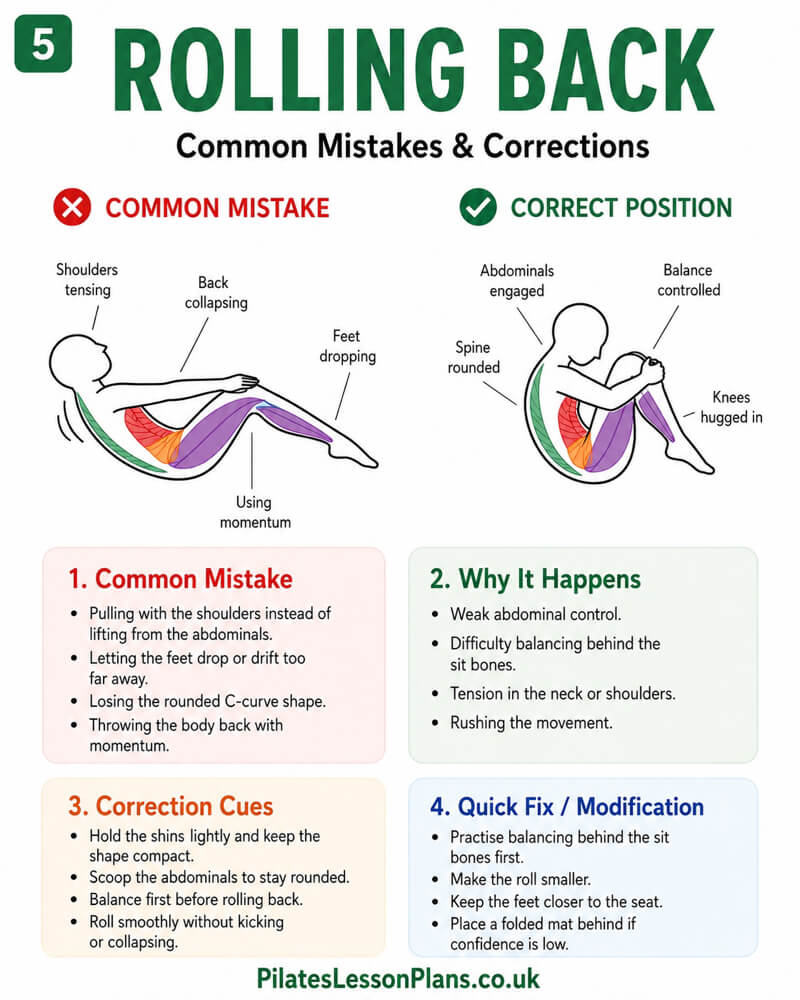
Rolling Back Pilates Common Mistakes & Corrections Card.
Common Mistake
In Rolling Back, students often throw the head back, flatten the spine, kick the legs, or use momentum to roll. The round ball shape disappears, and the exercise becomes less “spinal massage” and more “tiny Pilates cannonball”.
Why It Happens
This often happens when the abdominals are not controlling the curve, the student is trying to roll too far, or the balance point is unclear. If the spine loses its rounded shape, the roll becomes bumpy and unpredictable.
Correction Cues
Cue the student to keep the eyes towards the knees, draw the abdominals back, hold a rounded C-curve, and roll only to the shoulder blades. The head should not hit the mat or lead the movement.
Quick Fix / Modification
Practise balancing in the rounded shape without rolling first. Then add a very small rock back and return. If the shape cannot be held still, it probably is not ready to travel.
Get the full Pilates Common Mistakes & Corrections Card Deck here.
6. One Leg Stretch
Pilates Common Mistake & Correction Card
Click the image to enlarge it
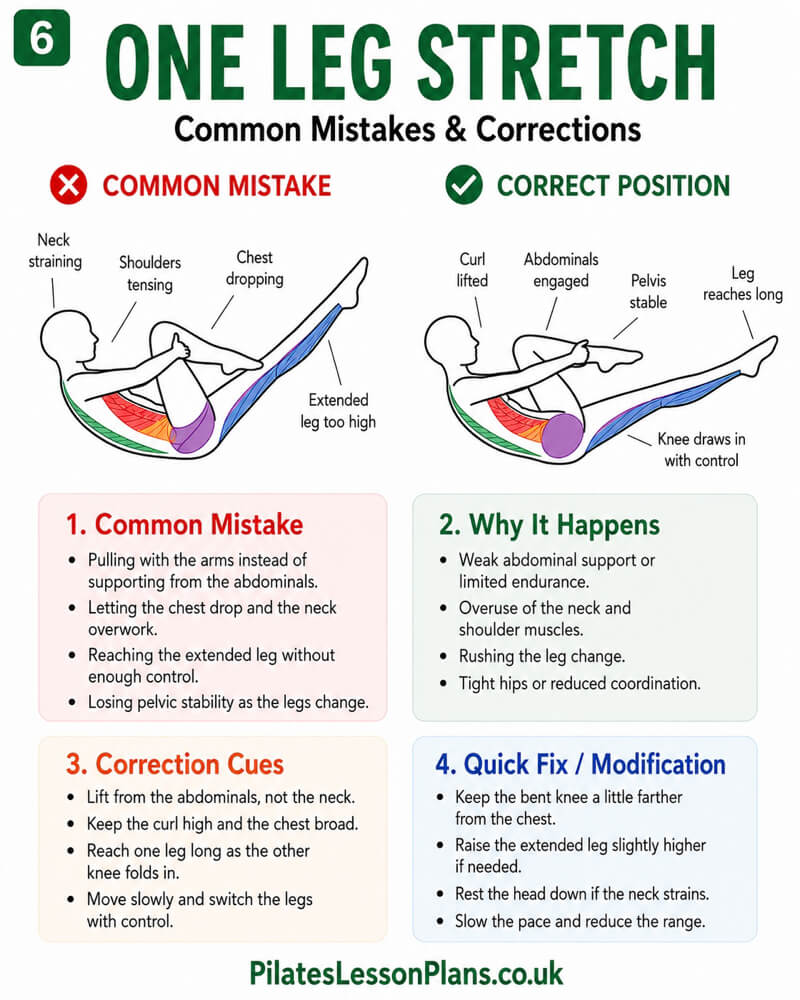
One Leg Stretch Pilates Common Mistakes & Corrections Card.
Common Mistake
In One Leg Stretch, students often pull too hard on the knee, lose the upper-body curl, strain the neck, or let the pelvis rock as the legs change. The movement becomes busy instead of precise.
Why It Happens
This usually happens when the legs move faster than the trunk can stabilise. The abdominals lose support, the shoulders creep up, and the hands start yanking the knee like it has important information.
Correction Cues
Cue the chest to stay lifted, the pelvis to stay steady, and the leg changes to be smooth and deliberate. Ask the student to draw the knee in with the abdominals, not by pulling aggressively with the arms.
Quick Fix / Modification
Keep the head down, bring the legs higher, or slow the tempo. The student can also practise the leg changes without the upper-body curl until the pelvis stays calm.
Get the full Pilates Common Mistakes & Corrections Card Deck here.
7. Double Leg Stretch
Pilates Common Mistake & Correction Card
Click the image to enlarge it
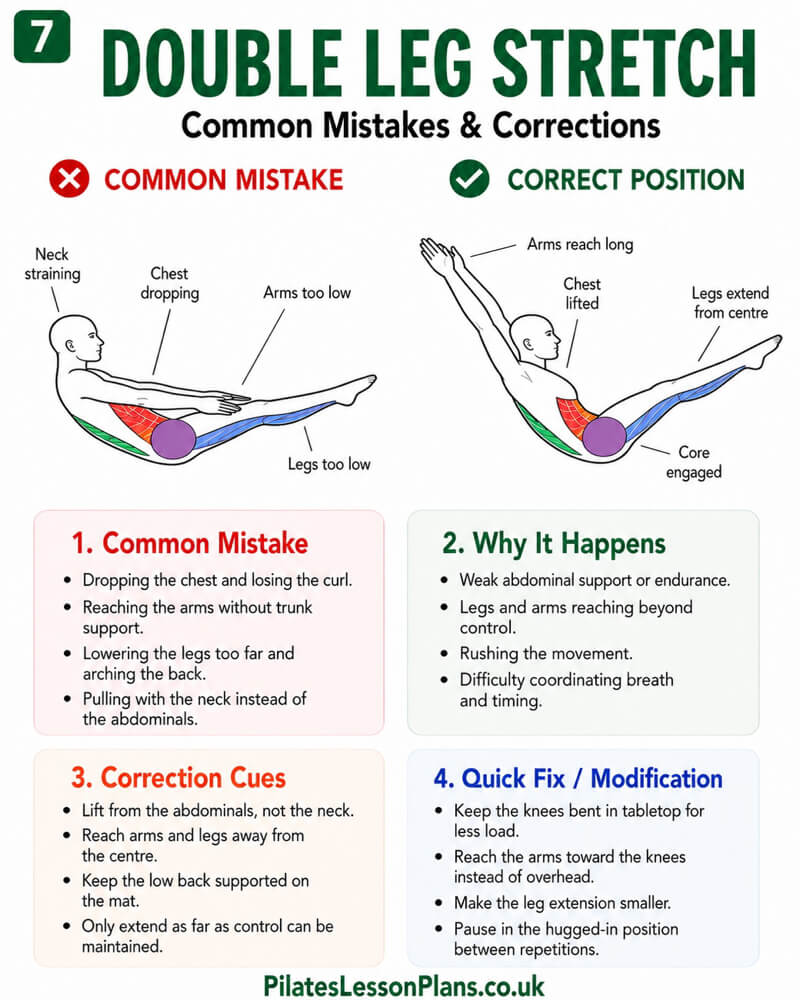
Double Leg Stretch Pilates Common Mistakes & Corrections Card.
Common Mistake
In Double Leg Stretch, students often reach the arms and legs too low or too far, causing the ribs to flare and the lower back to arch. The centre loses control and the exercise turns into a sleepy starfish collapse.
Why It Happens
This usually happens because the range is too large for the student’s current abdominal control. The limbs move away from the centre, the load increases, and the lower back tries to take over.
Correction Cues
Cue the ribs to stay heavy, the waist to stay supported, and the arms and legs to reach only as far as the trunk can remain organised. The curl should stay steady as the limbs move.
Quick Fix / Modification
Reach the legs higher, keep the knees bent, reduce the arm circle, or practise one limb movement at a time. Smaller and stronger beats bigger and bendy every time.
Get the full Pilates Common Mistakes & Corrections Card Deck here.
8. Spine Stretch
Pilates Common Mistake & Correction Card
Click the image to enlarge it
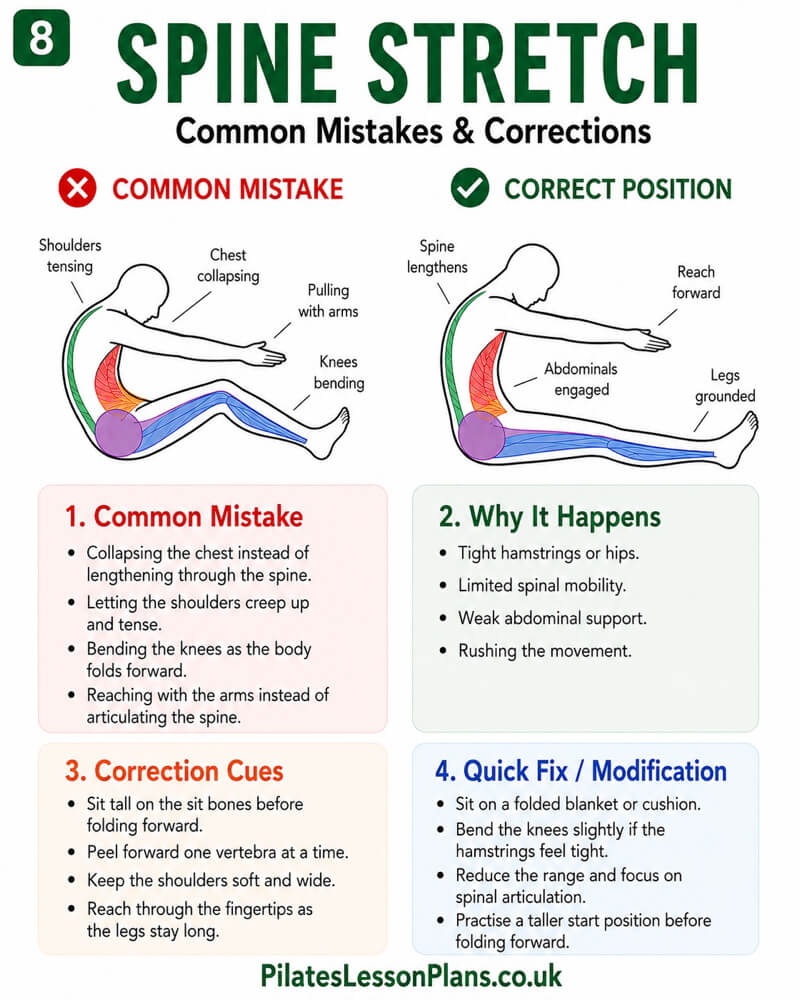
Spine Stretch Pilates Common Mistakes & Corrections Card.
Common Mistake
In Spine Stretch, students often slump from the chest, collapse the shoulders, lock the knees, or fold from the hips without creating a controlled spinal curl. The exercise becomes a disappointed sandwich rather than a spacious forward flexion.
Why It Happens
This can happen because the hamstrings are tight, the pelvis struggles to sit upright, or the student mistakes “reach forward” for “collapse forward”. The spine needs support, not surrender.
Correction Cues
Cue the student to sit tall first, draw the abdominals back, soften the shoulders, and round the spine forward with length. Imagine the crown of the head reaching away as the waist draws back.
Quick Fix / Modification
Sit on a folded towel, bend the knees slightly, or reduce the forward range. If the pelvis cannot sit tall, the spine will usually find a shortcut and call it a stretch.
Get the full Pilates Common Mistakes & Corrections Card Deck here.
9. Rocker With Open Legs
Pilates Common Mistake & Correction Card
Click the image to enlarge it
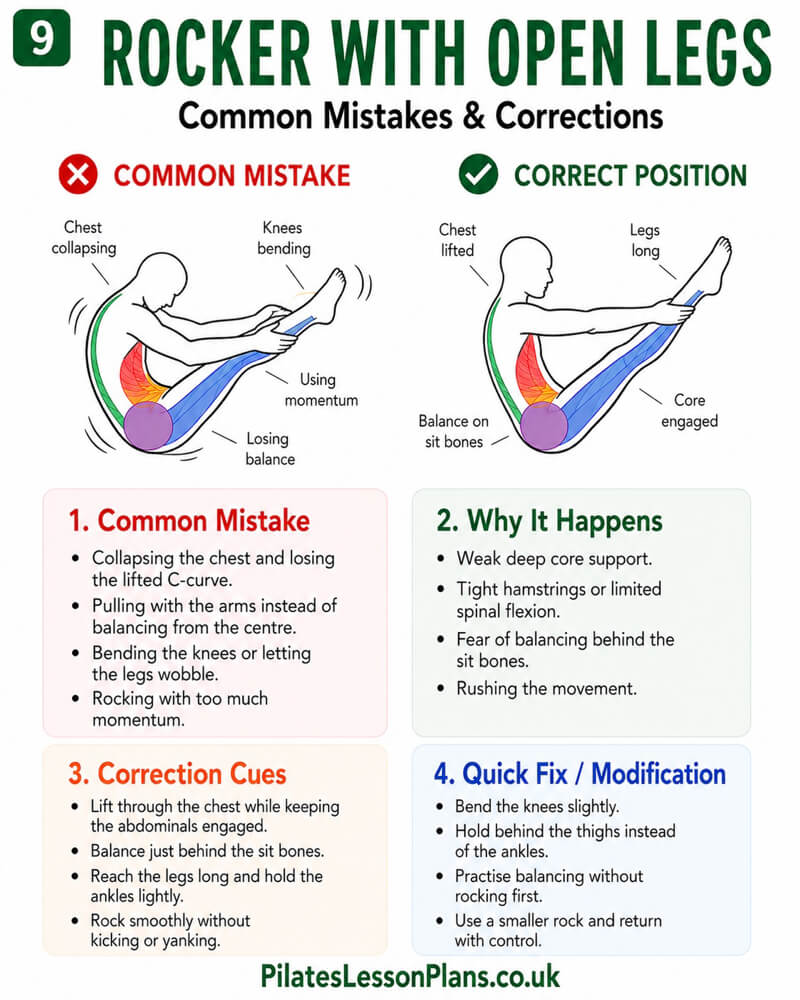
Rocker With Open Legs Pilates Common Mistakes & Corrections Card.
Common Mistake
In Rocker With Open Legs, students often straighten the legs at the expense of the spine, lose the C-curve, grip the shoulders, or roll back with too much speed. They may return upright by luck rather than control.
Why It Happens
This usually happens when hamstring flexibility, balance, and abdominal control are all being challenged at once. If the legs become the main event, the spine and centre often lose the plot.
Correction Cues
Cue the student to keep the spine rounded, the shoulders soft, and the abdominals drawing back. Ask them to balance before rolling, and return to the same shape they started with.
Quick Fix / Modification
Bend the knees, hold behind the thighs, or practise balance only. A stable bent-leg version is much more useful than a straight-leg version that rolls around like a surprised starfish.
Get the full Pilates Common Mistakes & Corrections Card Deck here.
10. Cork Screw
Pilates Common Mistake & Correction Card
Click the image to enlarge it
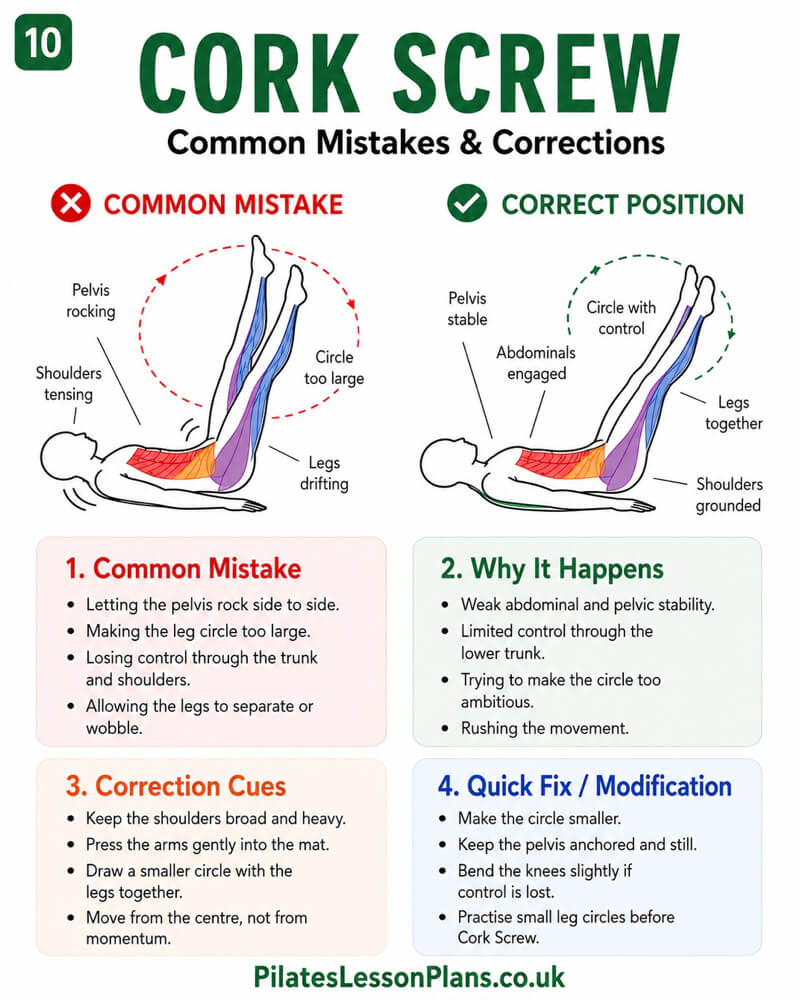
Cork Screw Pilates Common Mistakes & Corrections Card.
Common Mistake
In Cork Screw, students often make the circle too large, swing the legs, lift the shoulders, or allow the pelvis to roll wildly from side to side. The exercise can quickly become a tiny airborne washing machine.
Why It Happens
This usually happens when the legs overpower the centre. The abdominals and obliques are not controlling the pelvis, so the movement becomes momentum-based instead of precise.
Correction Cues
Cue the arms to press into the mat, the ribs to stay heavy, and the circle to be smaller and slower. Ask the student to move from the centre rather than letting the legs drag the pelvis around.
Quick Fix / Modification
Bend the knees, reduce the circle size, or practise side-to-side leg arcs before attempting the full circular movement. Control first. Fancy circles later.
Get the full Pilates Common Mistakes & Corrections Card Deck here.
11. Saw
Pilates Common Mistake & Correction Card
Click the image to enlarge it
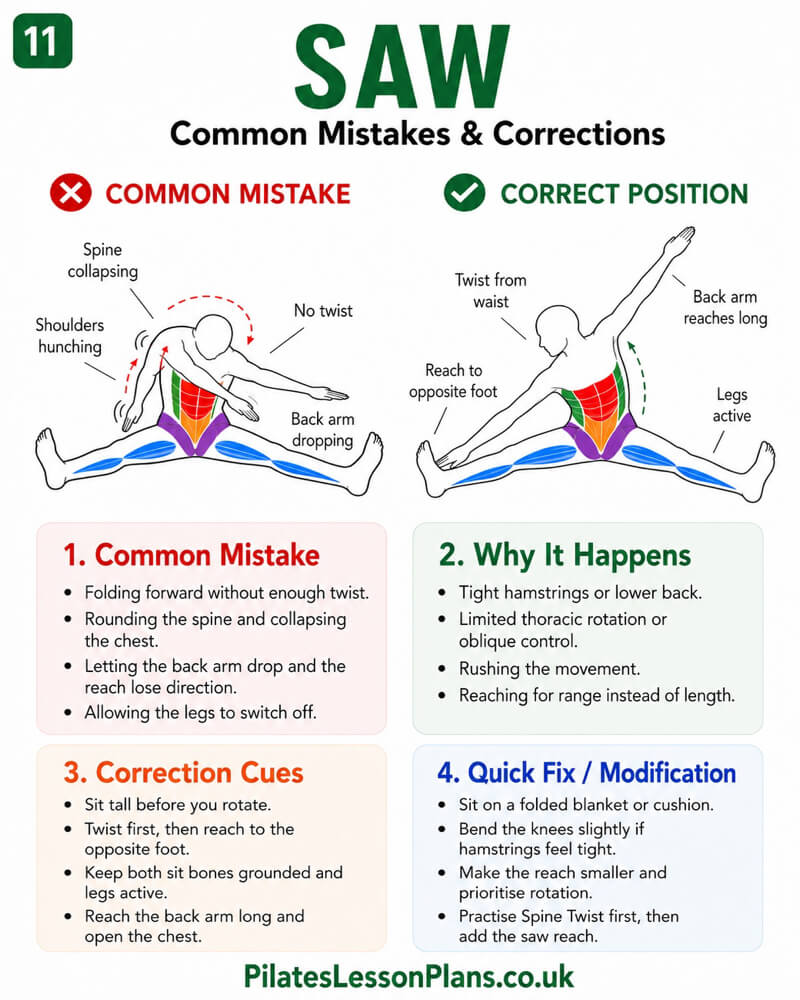
Saw Pilates Common Mistakes & Corrections Card.
Common Mistake
In Saw, students often twist from the arms instead of rotating through the spine. The pelvis may lift, the shoulders may round forward, and the reach can become a dramatic arm swipe rather than a controlled spinal rotation.
Why It Happens
This usually happens when the student focuses on touching the foot rather than rotating from the centre. Tight hamstrings, a rounded lower back, or limited spinal rotation can all encourage the body to cheat by lifting one hip or collapsing through the chest.
Correction Cues
Cue the student to sit tall first, anchor both sitting bones, rotate through the ribs and spine, and reach the opposite arm forward without collapsing the chest. The back arm should stay active, not disappear into the scenery.
Quick Fix / Modification
Sit on a folded towel, bend the knees slightly, or reduce the reach. A smaller, cleaner twist is better than sawing the air while the pelvis sneaks off sideways.
Get the full Pilates Common Mistakes & Corrections Card Deck here.
12. Swan Dive
Pilates Common Mistake & Correction Card
Click the image to enlarge it
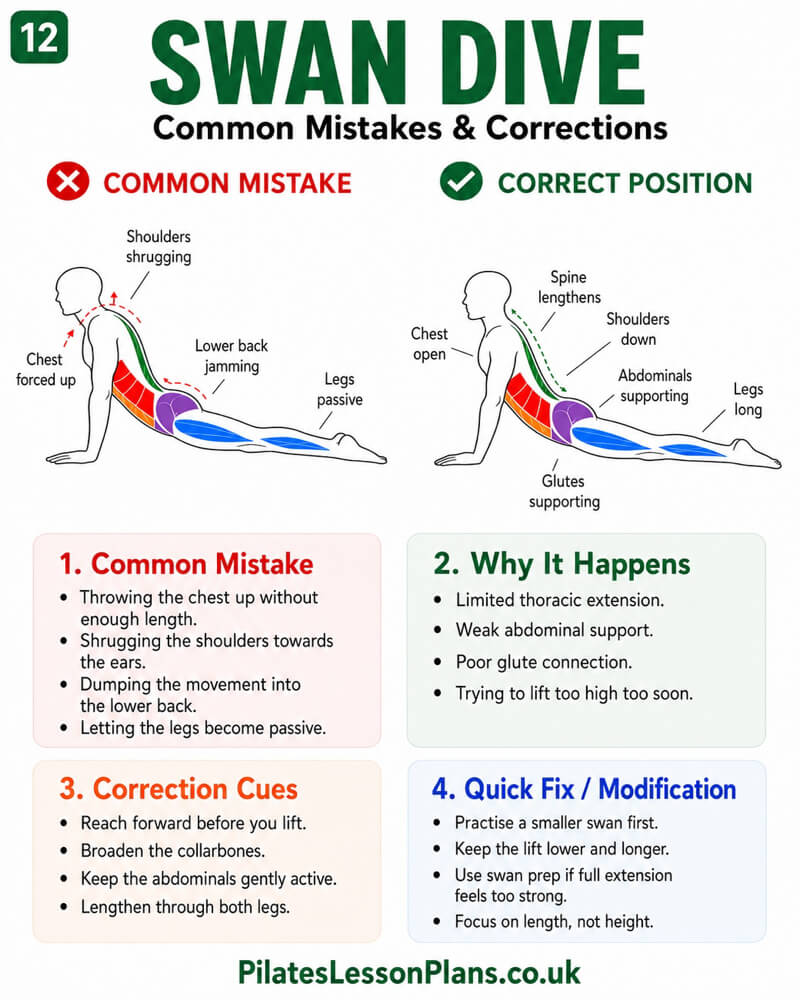
Swan Dive Pilates Common Mistakes & Corrections Card.
Common Mistake
In Swan Dive, students often throw the head up, compress the lower back, let the legs go floppy, or use momentum instead of a strong, organised back-body lift.
Why It Happens
This usually happens when the student tries to lift higher than their spinal extension and front-body support allow. The lower back becomes the heroic but overworked main character, while the abdominals, glutes, and upper back quietly leave the meeting.
Correction Cues
Cue length before height. Ask the student to reach the chest forward, keep the back of the neck long, support with the abdominals, and energise the legs. The lift should feel buoyant, not jammed into the lower spine.
Quick Fix / Modification
Practise a smaller Swan prep first, keeping the hands down and the legs grounded. Reduce the range until the student can extend through the whole spine rather than making the lower back do a solo performance.
Get the full Pilates Common Mistakes & Corrections Card Deck here.
13. One Leg Kick
Pilates Common Mistake & Correction Card
Click the image to enlarge it
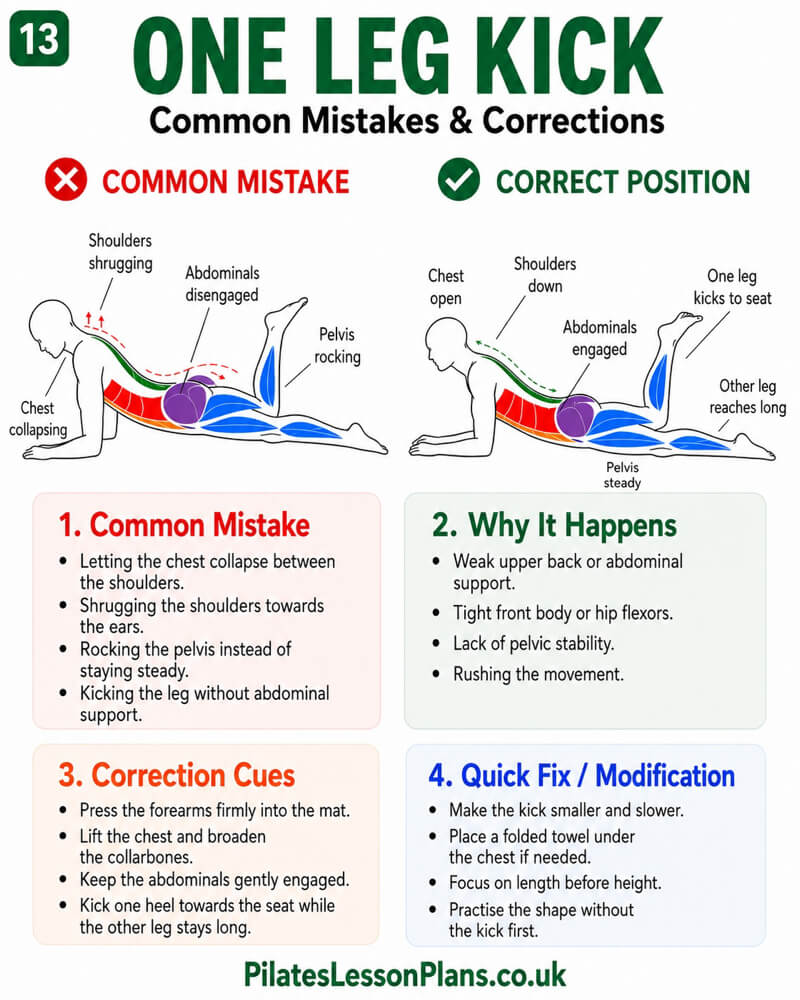
One Leg Kick Pilates Common Mistakes & Corrections Card.
Common Mistake
In One Leg Kick, students often collapse into the shoulders, poke the chin forward, rock the pelvis, or kick the heel towards the seat with very little control. The exercise becomes a tiny prone tap dance instead of a precise hamstring action.
Why It Happens
This usually happens when the upper body is not well supported through the forearms and shoulders, or when the pelvis is not stabilised by the abdominals and glutes. The leg moves, and the rest of the body gets dragged into the gossip.
Correction Cues
Cue the forearms to press down, the chest to stay broad, the neck to lengthen, and the pelvis to stay heavy and steady. Ask for a clear hamstring curl without bouncing the hips.
Quick Fix / Modification
Lower the chest slightly, reduce the kicking range, or practise the leg action more slowly. Keep the pelvis still before adding rhythm or speed.
Get the full Pilates Common Mistakes & Corrections Card Deck here.
14. Double Leg Kick
Pilates Common Mistake & Correction Card
Click the image to enlarge it
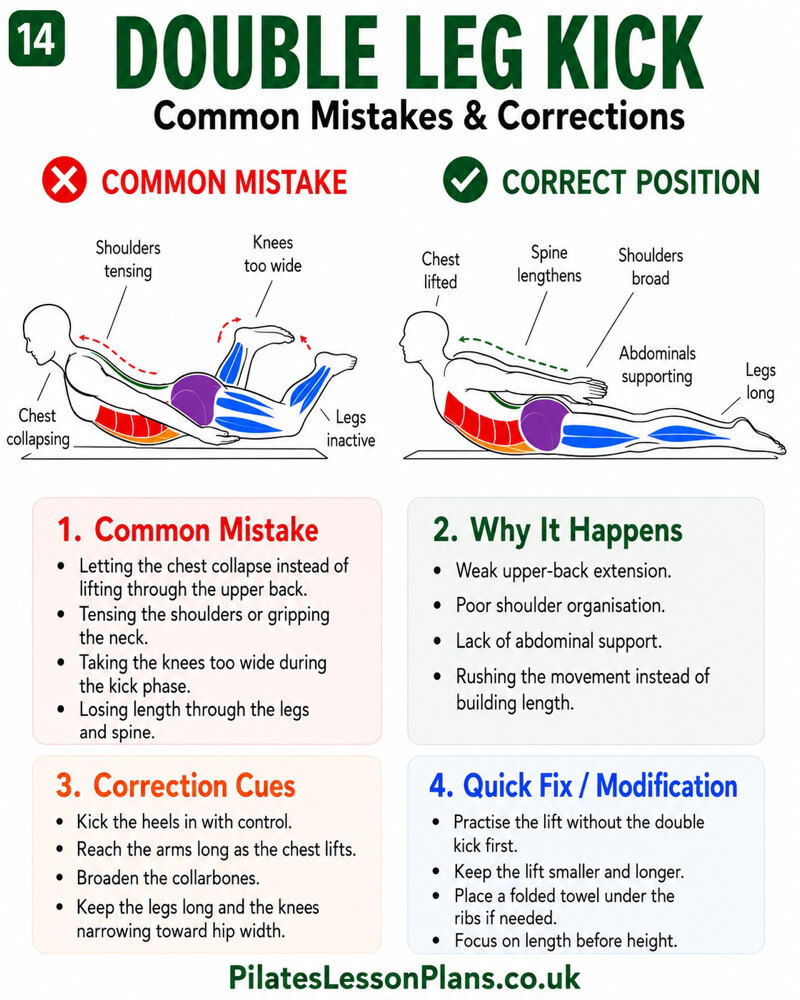
Double Leg Kick Pilates Common Mistakes & Corrections Card.
Common Mistake
In Double Leg Kick, students often kick the heels without organising the pelvis, over-arch the lower back during the lift, or pull the shoulders too far back. The movement can become a prone version of frantic swimming with extra choreography.
Why It Happens
This usually happens when the student focuses on the kick and forgets the whole-body organisation. The hamstrings may work, but the abdominals, glutes, upper back, and shoulders need to coordinate too.
Correction Cues
Cue the pelvis to stay grounded, the pubic bone to feel heavy, the legs to kick with control, and the chest to reach forward as it lifts. Encourage the shoulders to broaden rather than pinch aggressively.
Quick Fix / Modification
Reduce the height of the chest lift, slow the kicks, or practise the upper-body lift and leg kicks separately. Put the pieces together only when the lower back stays happy and the movement looks organised.
Get the full Pilates Common Mistakes & Corrections Card Deck here.
15. Neck Pull
Pilates Common Mistake & Correction Card
Click the image to enlarge it
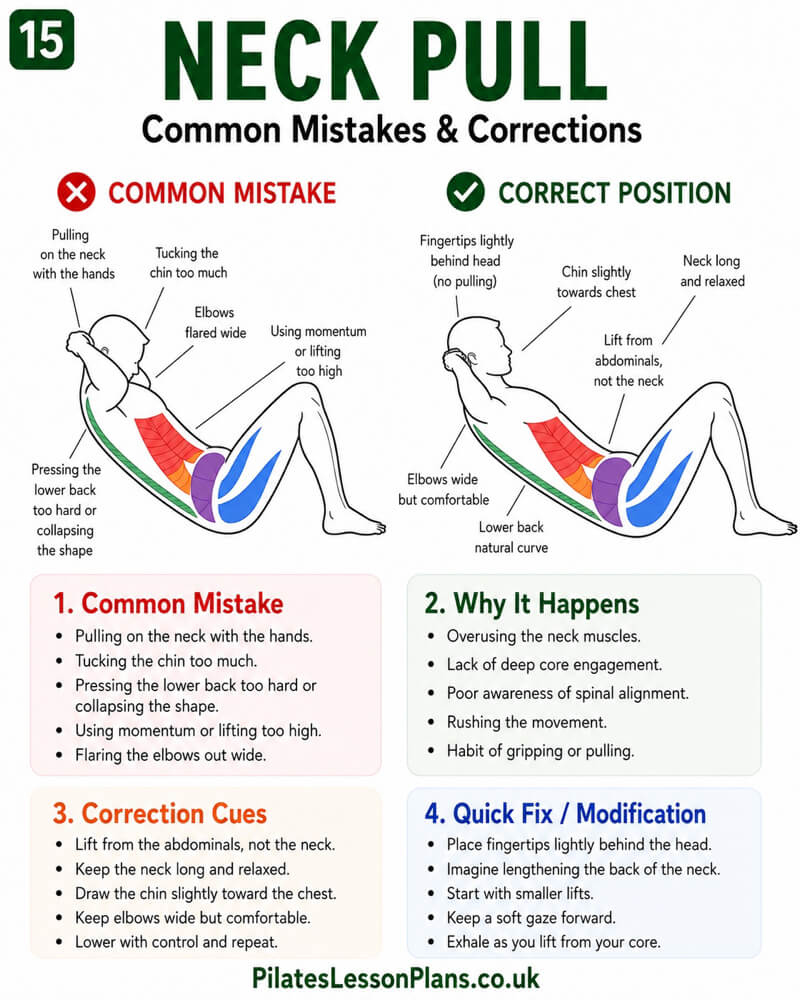
Neck Pull Pilates Common Mistakes & Corrections Card.
Common Mistake
In Neck Pull, students often yank on the head, flare the elbows, use momentum to sit up, or collapse forward over the legs. Despite the name, the aim is not to pull the neck like it has done something wrong.
Why It Happens
This usually happens because Neck Pull removes the helpful arm swing from Roll Up. Without enough abdominal control or spinal articulation, the hands behind the head become very tempting little winches.
Correction Cues
Cue the hands to support the head lightly, the elbows to stay wide but relaxed, and the abdominals to initiate the roll. Ask the student to keep the back of the neck long and avoid dragging the head forward.
Quick Fix / Modification
Cross the arms over the chest, bend the knees, or practise a smaller assisted roll-up. Build the control first, then return to the hands-behind-head version when the neck no longer feels personally attacked.
Get the full Pilates Common Mistakes & Corrections Card Deck here.
16. Scissors
Pilates Common Mistake & Correction Card
Click the image to enlarge it
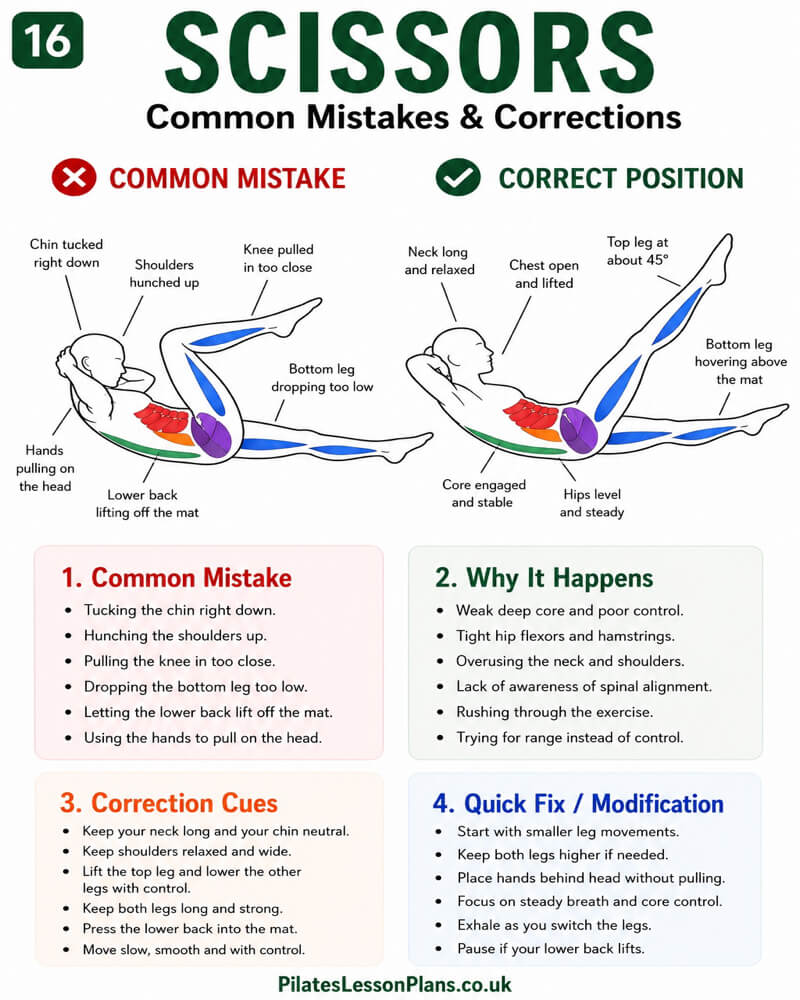
Scissors Pilates Common Mistakes & Corrections Card.
Common Mistake
In Scissors, students often collapse into the neck, let the pelvis drop, move the legs too quickly, or turn the scissor action into loose windscreen wipers. The support through the shoulders and upper back gets lost.
Why It Happens
This usually happens when the student does not have enough abdominal support, shoulder stability, or hamstring control to manage the inverted position while the legs switch.
Correction Cues
Cue the weight into the shoulders and upper back, the neck to stay free, and the pelvis to stay lifted. Ask for long, controlled leg switches rather than large, floppy movements.
Quick Fix / Modification
Practise hamstring stretches, supported shoulder bridge variations, or small leg switches with the pelvis lower. Avoid the full inverted version if the student cannot keep weight away from the neck.
Get the full Pilates Common Mistakes & Corrections Card Deck here.
17. Bicycle
Pilates Common Mistake & Correction Card
Click the image to enlarge it
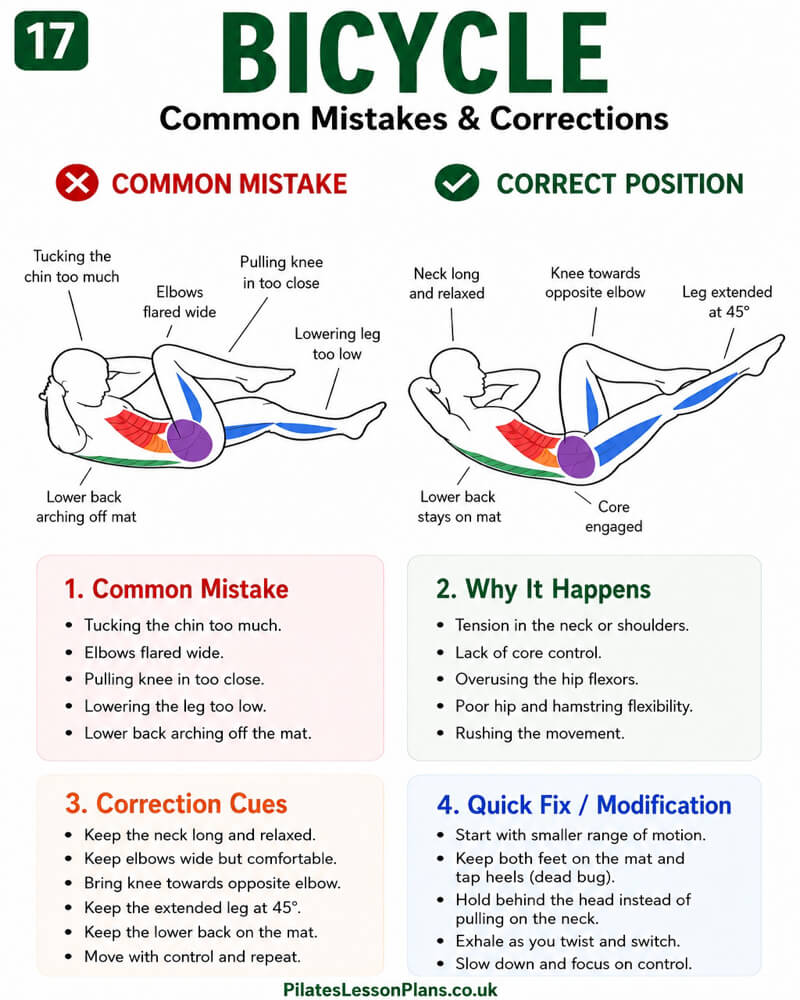
Bicycle Pilates Common Mistakes & Corrections Card.
Common Mistake
In Bicycle, students often pedal too quickly, drop the pelvis, strain the neck, or lose the clean cycling pathway. The legs may look busy, but the centre is quietly losing the argument.
Why It Happens
This usually happens when the student prioritises speed and range over support. The inverted position already asks a lot of the shoulders, abdominals, and pelvis; adding a cycling action can tip the whole thing into leg-based chaos.
Correction Cues
Cue the pelvis to stay high, the neck to stay relaxed, and the legs to pedal slowly and clearly. Ask the student to move as though cycling through thick honey rather than racing up an imaginary hill.
Quick Fix / Modification
Return to Scissors, practise smaller cycling movements, or keep the hips lower and supported. If the pelvis drops or the neck works too hard, simplify before continuing.
Get the full Pilates Common Mistakes & Corrections Card Deck here.
18. Shoulder Bridge
Pilates Common Mistake & Correction Card
Click the image to enlarge it
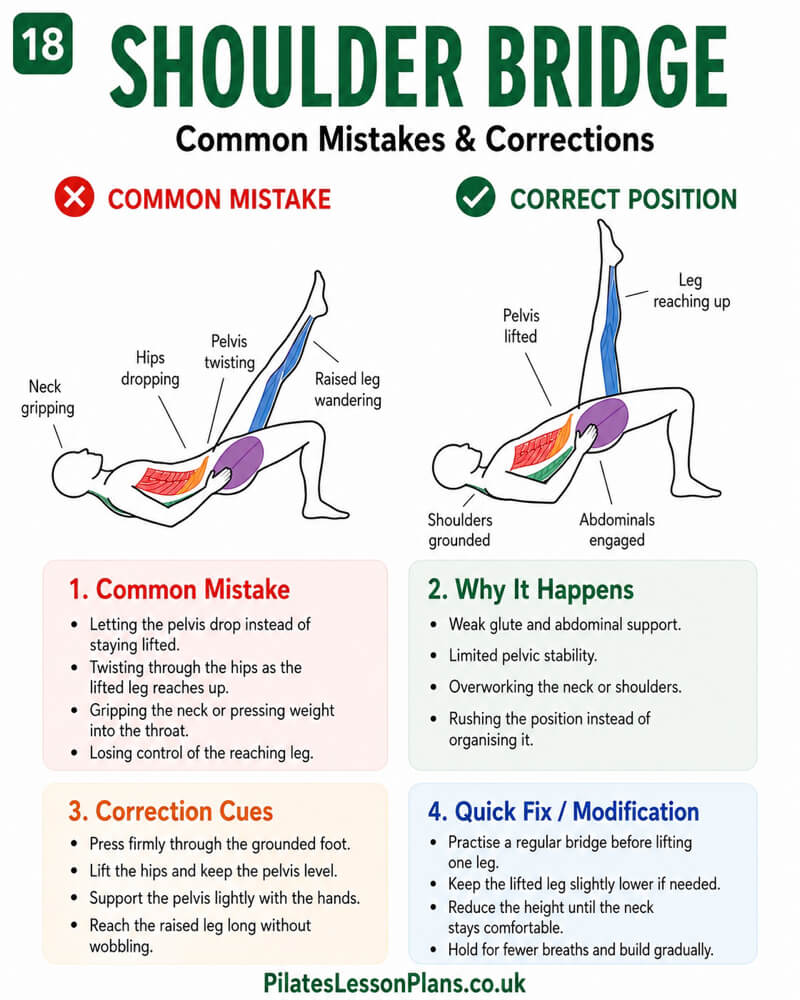
Shoulder Bridge Pilates Common Mistakes & Corrections Card.
Common Mistake
In Shoulder Bridge, students often flare the ribs, over-arch the lower back, let the hips drop, or allow the pelvis to wobble when one leg moves. The bridge becomes less “strong line” and more “wonky shelf”.
Why It Happens
This usually happens when the glutes, hamstrings, and abdominals are not sharing the workload. The student may push too much through the lower back or try to lift the leg without stabilising the pelvis first.
Correction Cues
Cue the ribs to soften, the pelvis to stay level, and the glutes and hamstrings to support the lift. Ask the student to imagine the hip bones staying like headlights pointing straight ahead.
Quick Fix / Modification
Keep both feet on the mat, reduce the height of the bridge, or practise tiny leg lifts only when the pelvis remains level. Strong and steady is better than high and wobbly.
Get the full Pilates Common Mistakes & Corrections Card Deck here.
19. Spine Twist
Pilates Common Mistake & Correction Card
Click the image to enlarge it
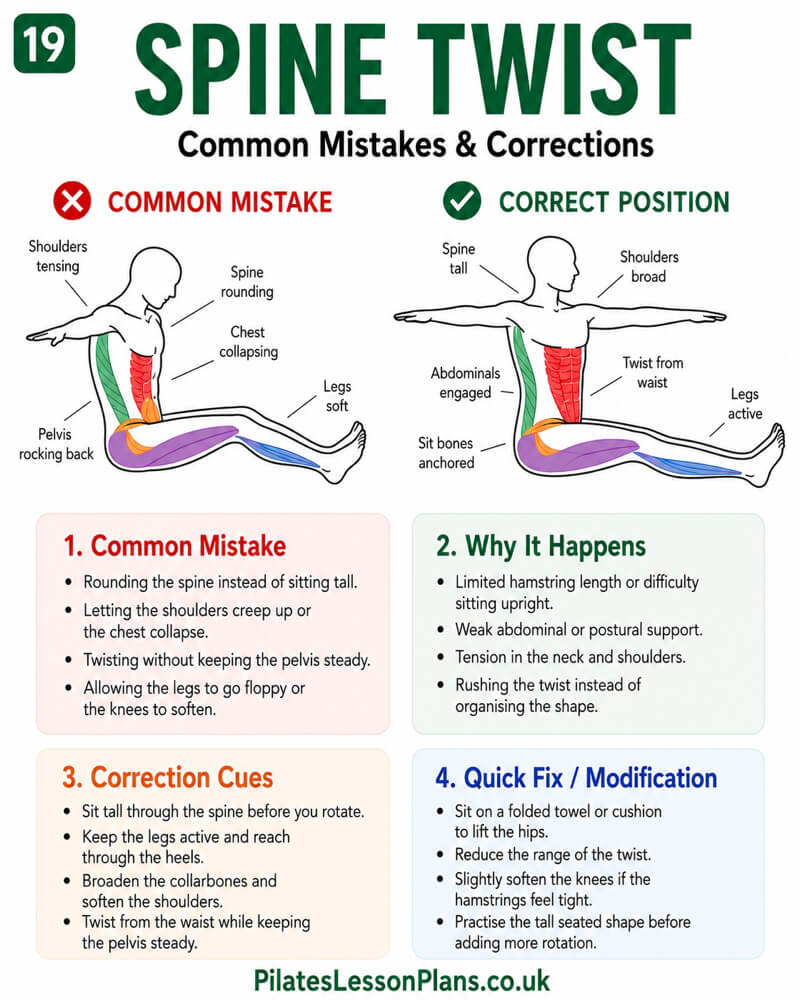
Spine Twist Pilates Common Mistakes & Corrections Card.
Common Mistake
In Spine Twist, students often swing the arms, lift the hips, round the spine, or twist from the shoulders instead of rotating through the trunk. The exercise can start to look like a polite office-chair swivel without the chair.
Why It Happens
This usually happens when the student is trying to turn too far. Limited spinal rotation, tight hamstrings, or difficulty sitting tall can all encourage the pelvis and arms to help more than they should.
Correction Cues
Cue the student to grow tall through the crown of the head, keep both sitting bones heavy, widen the arms, and rotate from the waist and ribs. The arms follow the spine; they do not drag it round.
Quick Fix / Modification
Sit on a folded towel, bend the knees, cross the arms over the chest, or make the twist much smaller. A small clean rotation is better than a big swivel with a wandering pelvis.
Get the full Pilates Common Mistakes & Corrections Card Deck here.
20. Jack Knife
Pilates Common Mistake & Correction Card
Click the image to enlarge it
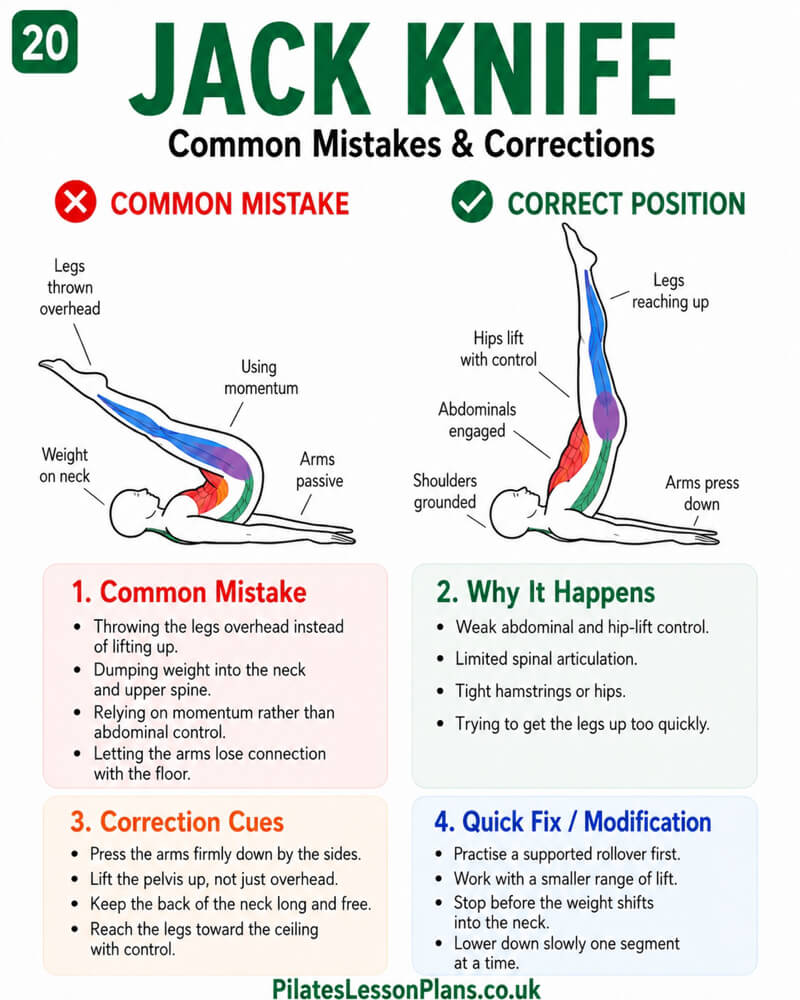
Jack Knife Pilates Common Mistakes & Corrections Card.
Common Mistake
In Jack Knife, students often throw the legs overhead, dump weight into the neck, use momentum to lift, or let the arms become passive. The legs may go skyward, but the control has quietly left the building.
Why It Happens
This usually happens because the student is trying to get the legs up too quickly. Weak abdominal and hip-lift control, limited spinal articulation, tight hamstrings, or poor shoulder grounding can all make the movement feel rushed and neck-heavy.
Correction Cues
Cue the arms to press firmly down, the pelvis to lift with control, and the legs to reach up rather than fling overhead. Keep the back of the neck long and make sure the weight stays on the shoulders and upper back.
Quick Fix / Modification
Practise a supported rollover first, work with a smaller range of lift, or stop before the weight shifts into the neck. Lower down slowly one segment at a time. Jack Knife is impressive, but the neck does not need a surprise promotion.
Get the full Pilates Common Mistakes & Corrections Card Deck here.
21. Side Kick
Pilates Common Mistake & Correction Card
Click the image to enlarge it
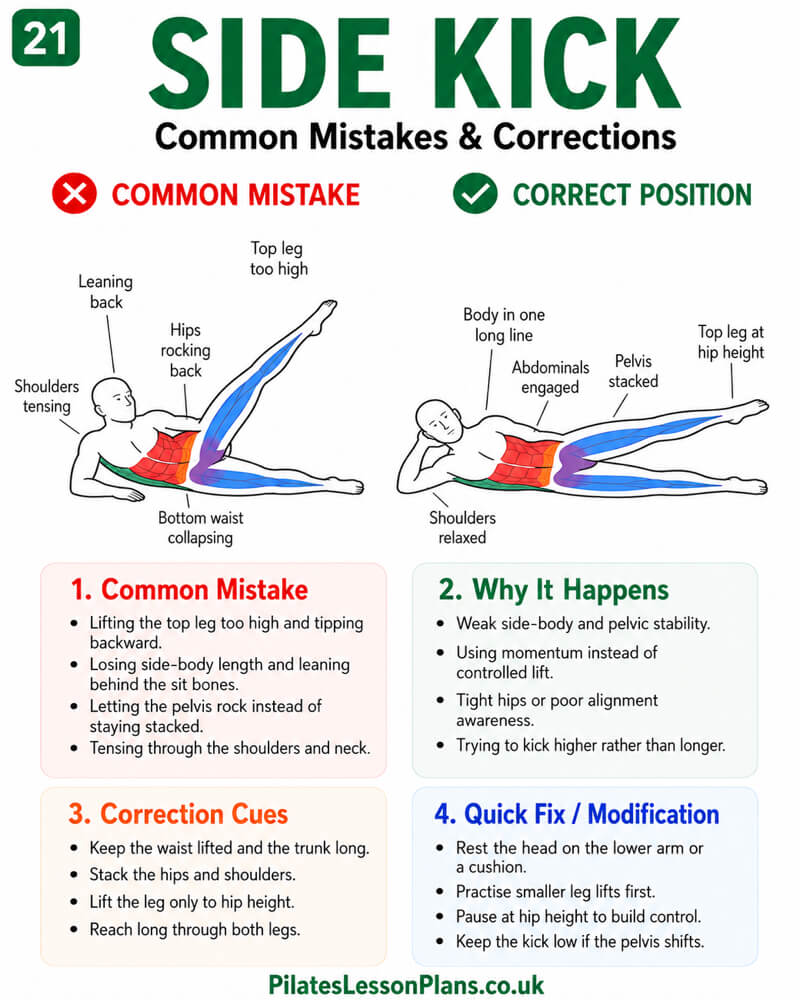
Side Kick Pilates Common Mistakes & Corrections Card.
Common Mistake
In Side Kick, students often swing the leg too far, roll the pelvis forward and back, collapse into the waist, or grip the shoulders. The top leg looks busy, but the trunk has quietly joined the drama.
Why It Happens
This usually happens when the leg swing is larger than the student’s hip control. The pelvis borrows movement from the waist, spine, or shoulders, and the exercise becomes a side-lying pendulum with ambition.
Correction Cues
Cue the waist to stay lifted, the pelvis to stay stacked, and the leg to move from the hip socket. Ask the student to make the kick smaller and smoother while keeping the upper body quiet.
Quick Fix / Modification
Reduce the range, bend the bottom leg for support, or place one hand in front of the body for balance. The goal is leg movement with trunk control, not a rolling side-body adventure.
Get the full Pilates Common Mistakes & Corrections Card Deck here.
22. Teaser
Pilates Common Mistake & Correction Card
Click the image to enlarge it
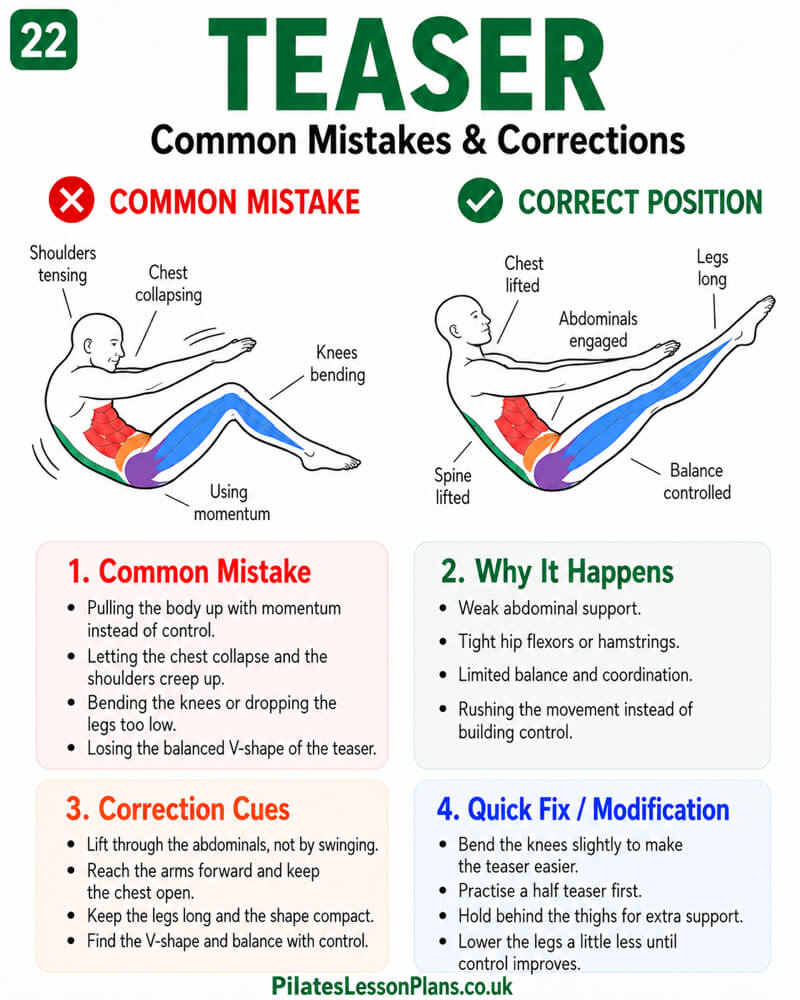
Teaser Pilates Common Mistakes & Corrections Card.
Common Mistake
In Teaser, students often grip the hip flexors, round the shoulders, hold the breath, throw the arms, or collapse backwards out of the V-shape. The face may say “serene”, but the body is quietly negotiating with gravity.
Why It Happens
This usually happens because Teaser asks for abdominal strength, hip flexor control, hamstring length, spinal articulation, and balance all at once. That is a lot of departments trying to attend one meeting.
Correction Cues
Cue the student to reach through the legs, lift through the chest, soften the shoulders, and draw the abdominals back. The arms should support the line, not fling the body into position.
Quick Fix / Modification
Bend the knees, hold behind the thighs, practise one-leg Teaser, or start from a smaller range. A supported Teaser with control is much more useful than a full Teaser that looks like a polite wobble pretending to be fine.
Get the full Pilates Common Mistakes & Corrections Card Deck here.
23. Hip Twist
Pilates Common Mistake & Correction Card
Click the image to enlarge it
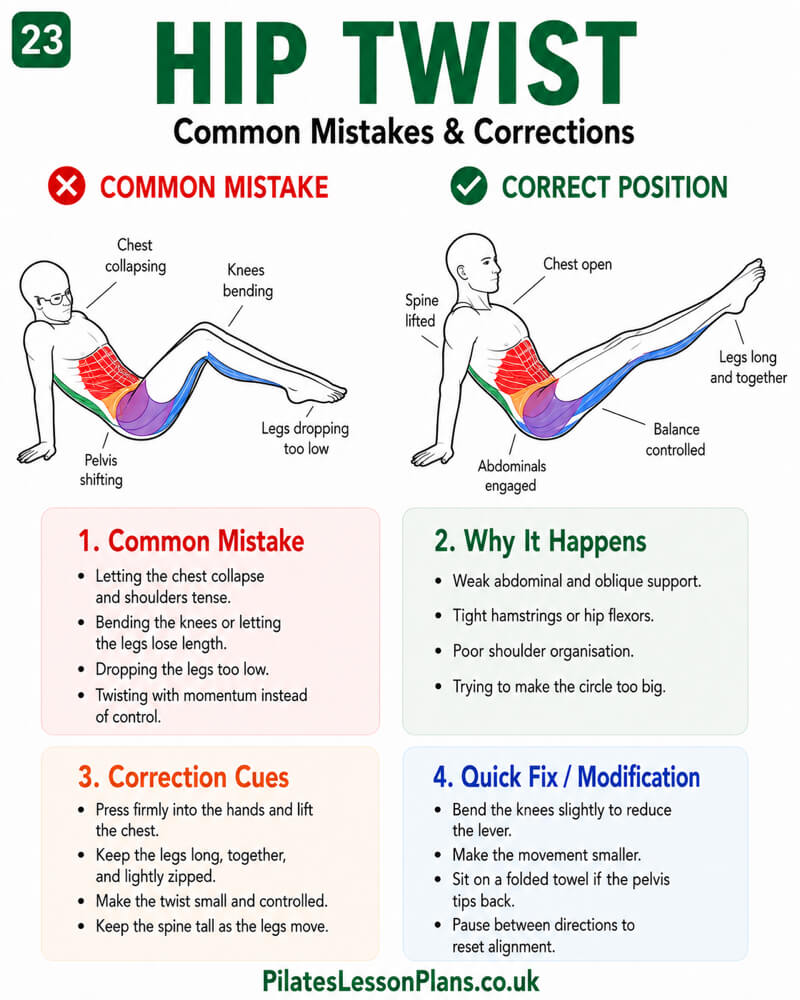
Hip Twist Pilates Common Mistakes & Corrections Card.
Common Mistake
In Hip Twist, students often collapse the chest, hike the shoulders, bend the elbows, or let the legs drag the pelvis around. The circle becomes too large, and the centre loses its steering wheel.
Why It Happens
This usually happens when the student tries to make a big leg circle without enough abdominal, oblique, or shoulder support. The legs take over, and the trunk becomes a passenger.
Correction Cues
Cue the chest to stay open, the arms to press into the mat, the shoulders to stay broad, and the circle to be controlled from the centre. Ask for a smaller circle with stronger support.
Quick Fix / Modification
Bend the knees, reduce the range, or practise holding the start position before adding the circle. If the upper body collapses, the leg circle is probably too ambitious.
Get the full Pilates Common Mistakes & Corrections Card Deck here.
24. Swimming
Pilates Common Mistake & Correction Card
Click the image to enlarge it
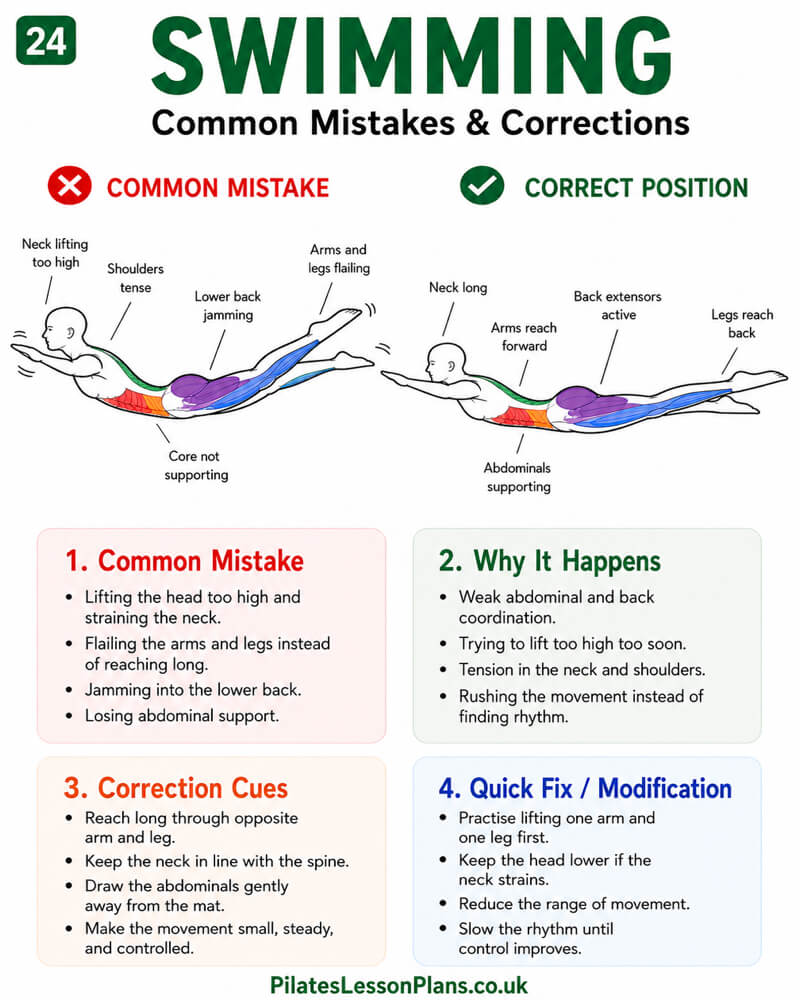
Swimming Pilates Common Mistakes & Corrections Card.
Common Mistake
In Swimming, students often lift the head too high, grip the lower back, flap the arms and legs without rhythm, or lose abdominal support. It can quickly become an emergency paddle on dry land.
Why It Happens
This usually happens when the student tries to lift too high or move too fast. The back body works, but without abdominal support and spinal length, the lower back and neck start collecting all the drama.
Correction Cues
Cue the student to lengthen through the crown of the head and toes, keep the gaze down, draw the abdominals gently away from the mat, and make the arm and leg movements small and rhythmic.
Quick Fix / Modification
Practise opposite arm and leg lifts slowly, or keep the arms down and work only the legs. The aim is coordinated extension, not splashing about like a startled duck.
Get the full Pilates Common Mistakes & Corrections Card Deck here.
25. Leg Pull Front
Pilates Common Mistake & Correction Card
Click the image to enlarge it
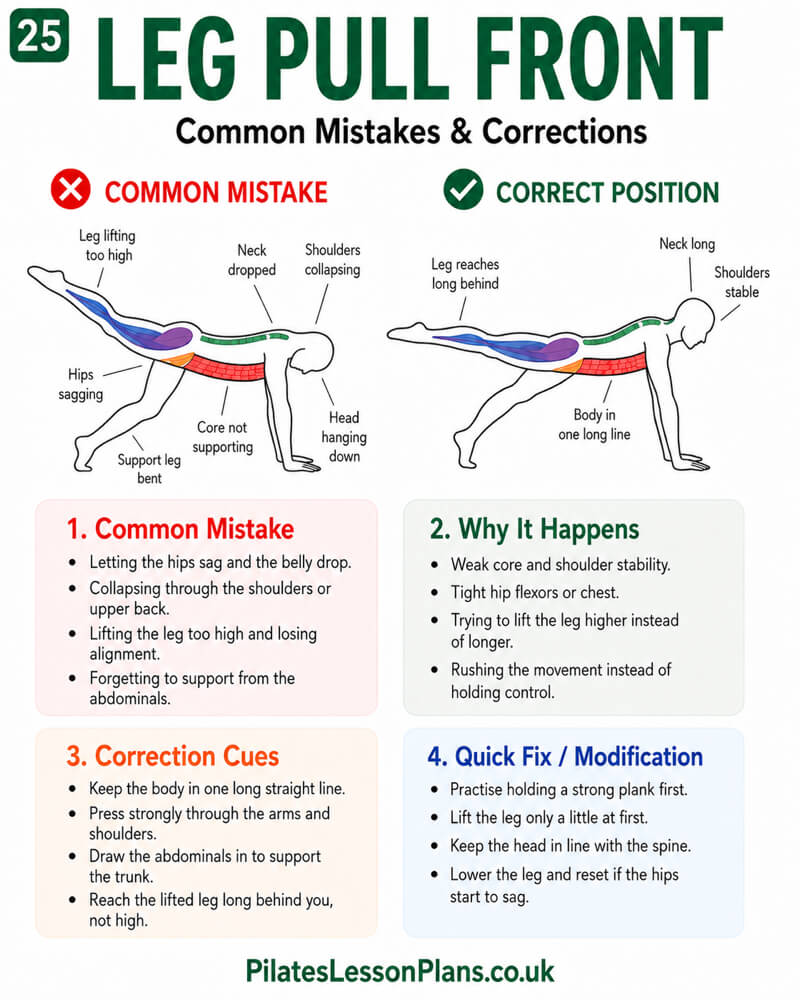
Leg Pull Front Pilates Common Mistakes & Corrections Card.
Common Mistake
In Leg Pull Front, students often drop the hips, sink between the shoulders, lock the elbows, or lift the leg by arching the lower back. The plank line slowly loses confidence.
Why It Happens
This usually happens when the shoulders, abdominals, glutes, and legs are not sharing the load. The leg lift challenges the plank, and the body tries to solve the problem by sagging, twisting, or dumping into the wrists.
Correction Cues
Cue the hands to press the floor away, the upper back to stay broad, the abdominals to support the waist, and the lifted leg to reach long rather than high. Keep the pelvis level.
Quick Fix / Modification
Hold a front support plank without the leg lift first. Then add tiny leg lifts or lower to the knees. The student needs a strong plank before adding “one leg has left the building”.
Get the full Pilates Common Mistakes & Corrections Card Deck here.
26. Leg Pull
Pilates Common Mistake & Correction Card
Click the image to enlarge it
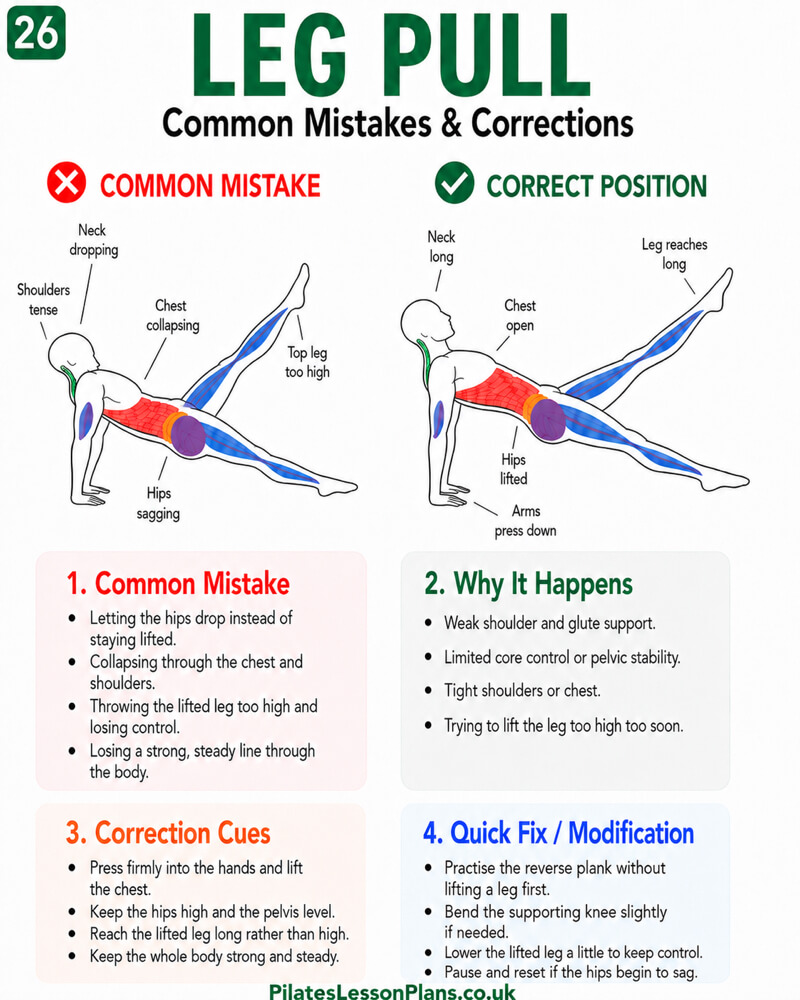
Leg Pull Pilates Common Mistakes & Corrections Card.
Common Mistake
In Leg Pull, students often sag the hips, flare the ribs, drop the head back, or collapse through the shoulders and wrists. The reverse plank starts looking suspiciously like a hammock audition.
Why It Happens
This usually happens when the posterior chain, shoulders, wrists, and abdominals are not organised enough to hold the reverse support shape. Adding a leg lift makes the whole system more demanding.
Correction Cues
Cue the chest to stay open, the shoulders to press down and back, the glutes to lift the pelvis, and the ribs to stay organised. Keep the head in line with the spine rather than dropping it back heavily.
Quick Fix / Modification
Bend the knees into a reverse tabletop, keep both feet down, or practise small pelvic lifts before adding the leg lift. Build the reverse support before asking one leg to show off.
Get the full Pilates Common Mistakes & Corrections Card Deck here.
27. Side Kick Kneeling
Pilates Common Mistake & Correction Card
Click the image to enlarge it
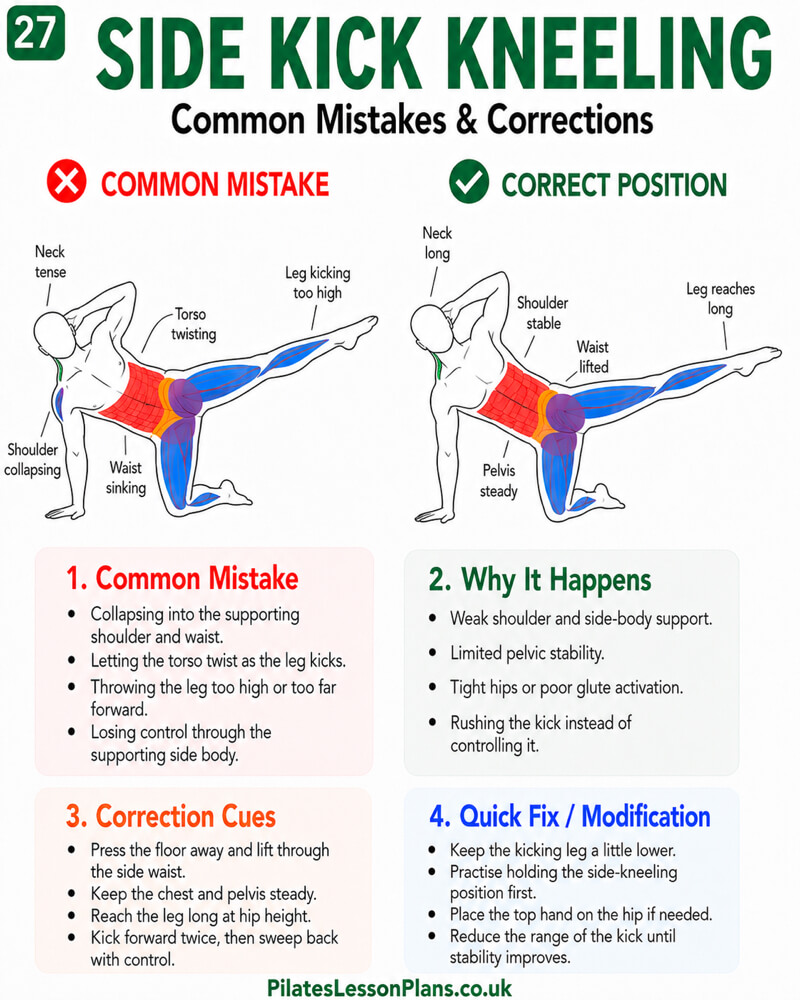
Side Kick Kneeling Pilates Common Mistakes & Corrections Card.
Common Mistake
In Side Kick Kneeling, students often collapse into the supporting shoulder, sink the waist, throw the top leg, or twist the pelvis. The body starts to resemble a side plank that has lost its instruction manual.
Why It Happens
This usually happens because the side body, shoulder, and hip stabilisers are being challenged at the same time. If the support arm or waist collapses, the moving leg quickly takes everyone down with it.
Correction Cues
Cue the supporting hand to press the floor away, the waist to lift, the chest to stay open, and the top leg to reach long from the hip. Keep the pelvis stacked and the movement small enough to control.
Quick Fix / Modification
Reduce the leg swing, place the bottom hand on a block, or practise the kneeling side support shape without moving the leg. Stability first, fancy kicking later.
Get the full Pilates Common Mistakes & Corrections Card Deck here.
28. Side Bend
Pilates Common Mistake & Correction Card
Click the image to enlarge it
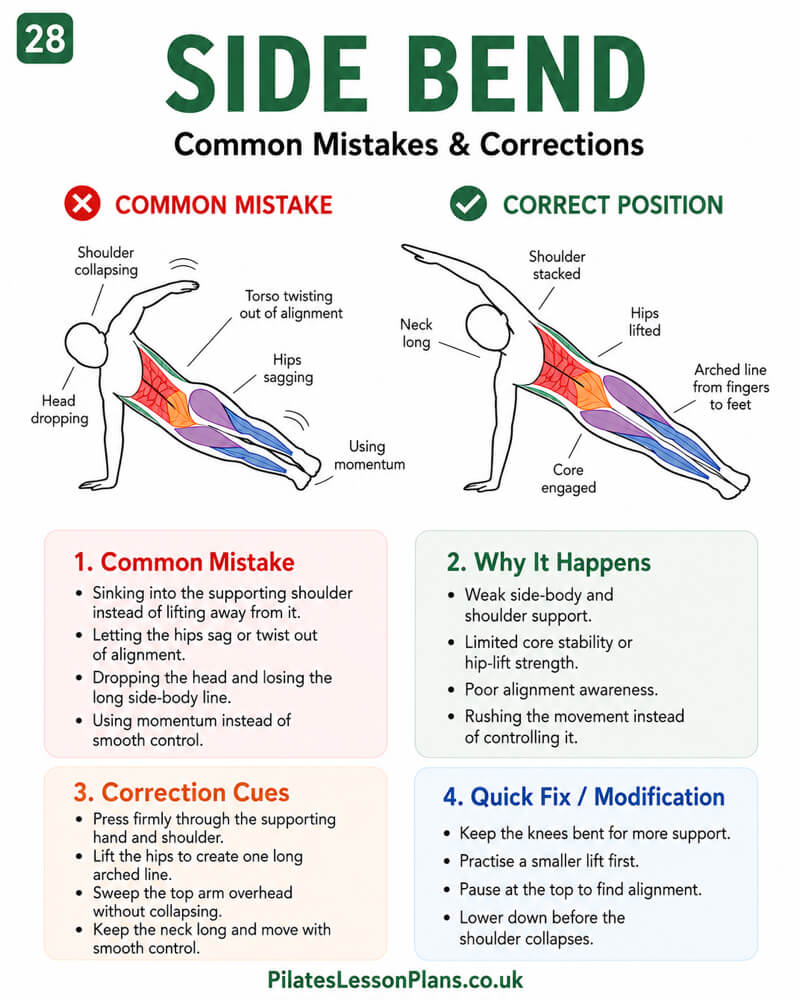
Side Bend Pilates Common Mistakes & Corrections Card.
Common Mistake
In Side Bend, students often sink into the supporting shoulder, drop the hips, twist the chest, or let the top arm collapse forward. The side body stops lifting, and the exercise becomes a slightly decorative shoulder protest.
Why It Happens
This usually happens when the shoulder, side waist, and hips are not strong enough to support the full side-bending shape. The student may also be trying to lift too high without enough control.
Correction Cues
Cue the supporting hand to press the floor away, the ribs to lift, the hips to rise, and the chest to stay open. Ask the student to create a long arc rather than dumping weight into the shoulder.
Quick Fix / Modification
Bend the knees, keep the bottom knee down, or practise a smaller lift. The side body should feel awake and supportive, not as if the shoulder has been left holding the entire meeting.
Get the full Pilates Common Mistakes & Corrections Card Deck here.
29. Boomerang
Pilates Common Mistake & Correction Card
Click the image to enlarge it
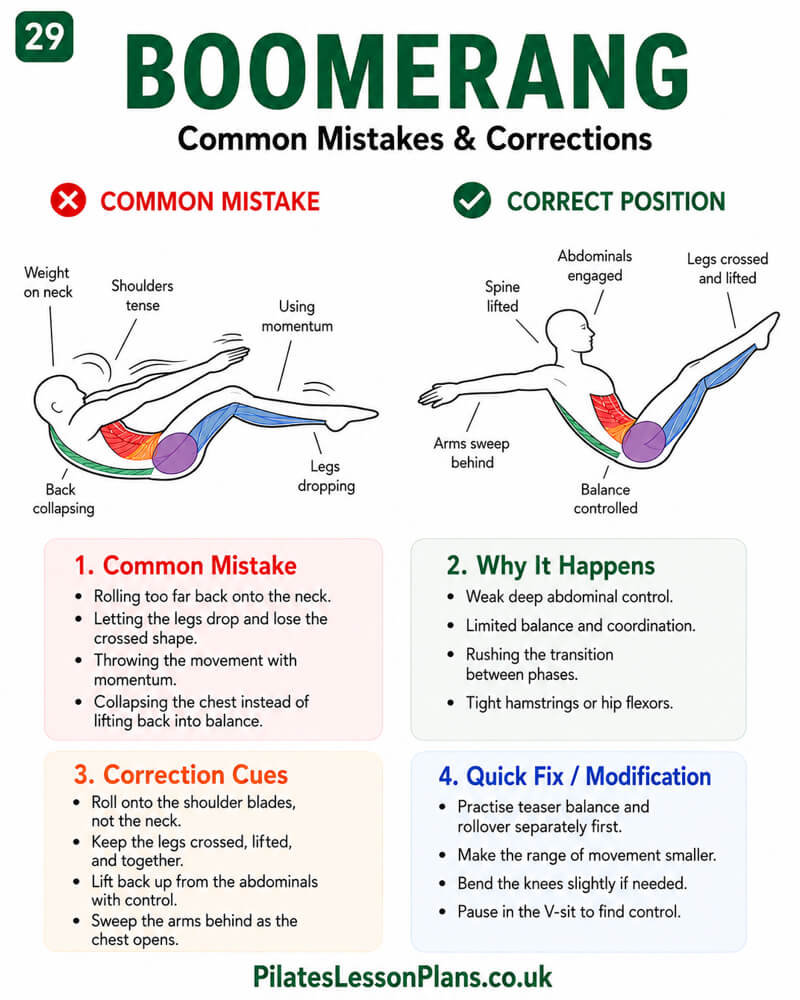
Boomerang Pilates Common Mistakes & Corrections Card.
Common Mistake
In Boomerang, students often use momentum, lose the leg cross, collapse the chest, or rush the transition from rolling to Teaser. The exercise can become a Pilates magic trick where nobody is quite sure what just happened.
Why It Happens
This usually happens because Boomerang combines rolling, coordination, balance, spinal articulation, and leg control in one very opinionated package. If one part is rushed, the whole sequence becomes messy.
Correction Cues
Cue the student to slow the transitions, keep the legs active, maintain the spinal curve during the roll, and lift into Teaser with control. Ask them to treat each phase as deliberate, not accidental.
Quick Fix / Modification
Break the exercise into parts: practise Roll Over, Teaser, and arm reach separately before linking them. Boomerang is much less mysterious when it is not performed at escape velocity.
Get the full Pilates Common Mistakes & Corrections Card Deck here.
30. Seal
Pilates Common Mistake & Correction Card
Click the image to enlarge it
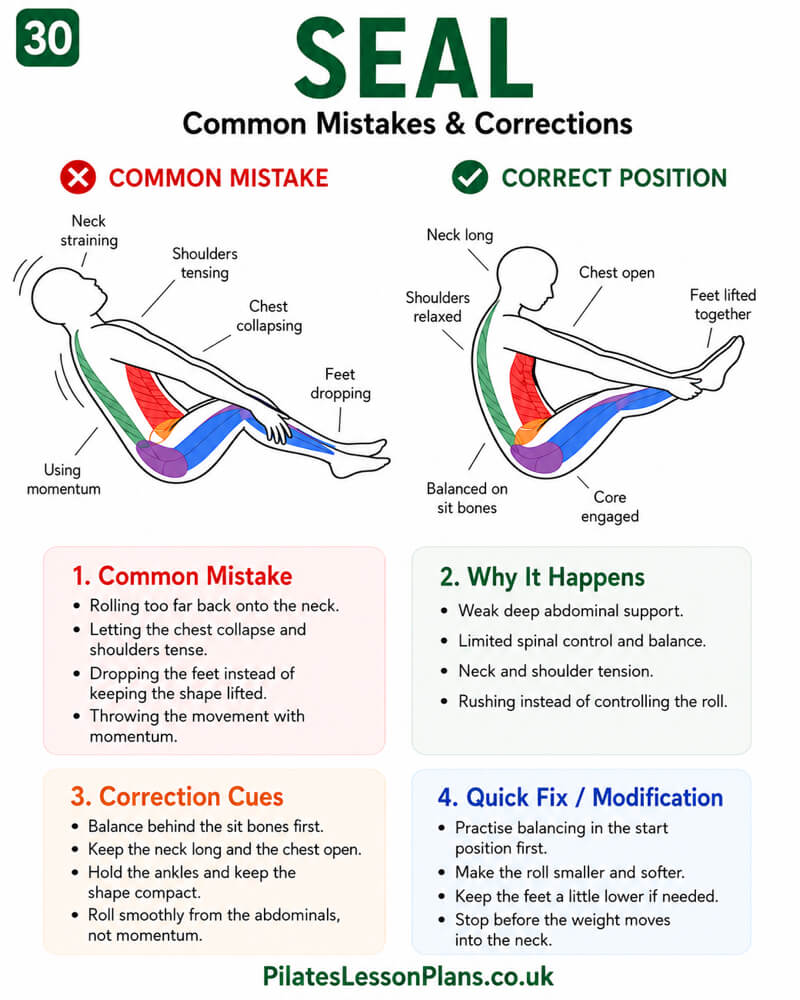
Seal Pilates Common Mistakes & Corrections Card.
Common Mistake
In Seal, students often flatten the spine, throw the head back, clap the feet by yanking the legs, or roll with too much speed. The playful rhythm turns into a tiny seal-shaped escape attempt.
Why It Happens
This usually happens when the student loses the rounded shape or focuses too much on the foot clap. Without abdominal support and a clear C-curve, the roll becomes bumpy and unpredictable.
Correction Cues
Cue the student to keep the eyes towards the centre, draw the abdominals back, maintain the rounded spine, and clap the feet lightly without disturbing the shape.
Quick Fix / Modification
Practise the balance position first, then add small rocks. Remove the foot clap if it causes the shape to collapse. The clap is decoration; the rounded control is the main event.
Get the full Pilates Common Mistakes & Corrections Card Deck here.
31. Crab
Pilates Common Mistake & Correction Card
Click the image to enlarge it
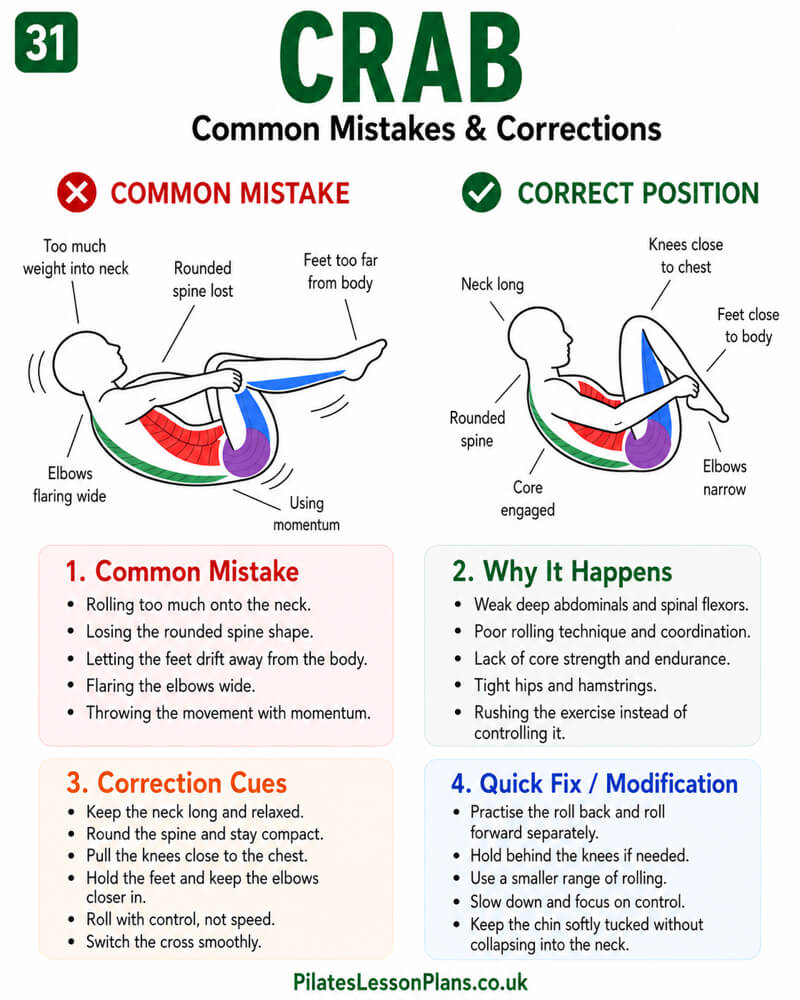
Crab Pilates Common Mistakes & Corrections Card.
Common Mistake
In Crab, students often put too much weight onto the head or neck, lose the rounded spine, or roll with too much force. This is one of those exercises where enthusiasm needs a sensible adult in the room.
Why It Happens
This usually happens when the student rolls too far or lacks the abdominal control to manage the transition. The neck should never become the landing platform for the exercise.
Correction Cues
Cue the student to keep the spine deeply rounded, move slowly, and avoid placing weight into the head or neck. The movement should stay controlled through the centre and upper back.
Quick Fix / Modification
Practise Rolling Back or Seal instead, or work only the balance shape. Keep the exercise small and safe. Crab is not the place for neck-based bravery.
Get the full Pilates Common Mistakes & Corrections Card Deck here.
32. Rocking
Pilates Common Mistake & Correction Card
Click the image to enlarge it
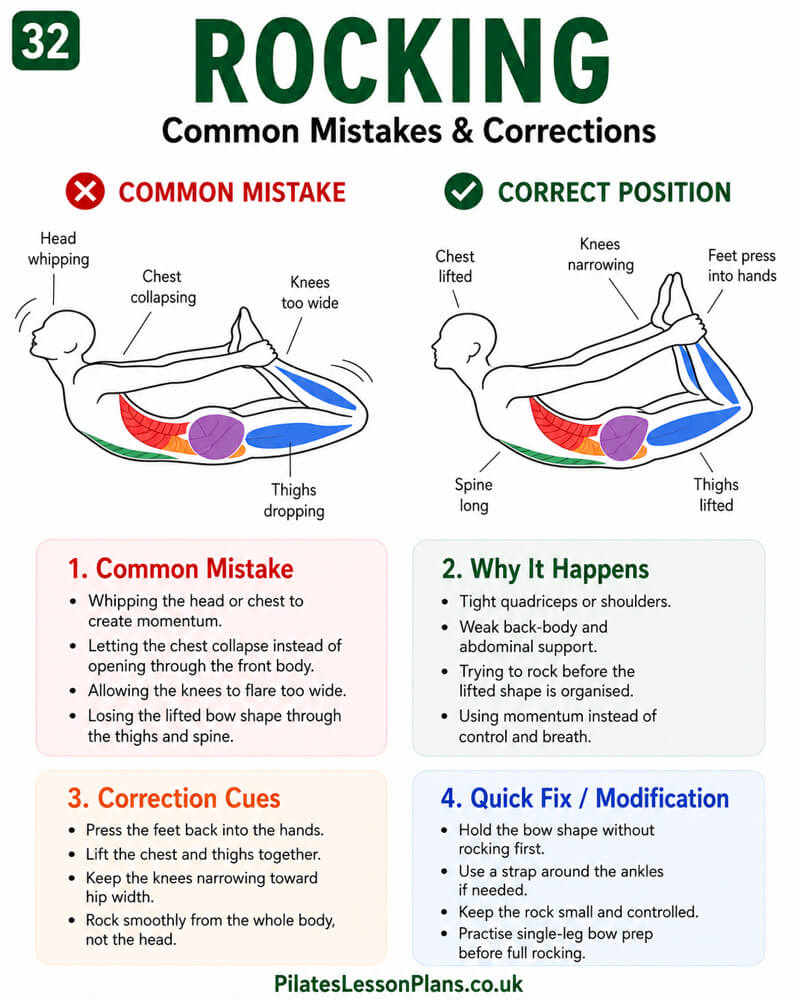
Rocking Pilates Common Mistakes & Corrections Card.
Common Mistake
In Rocking, students often pull hard on the feet, compress the lower back, throw the head up, or let the knees splay too wide. The shape may look dramatic, but the spine is not always enjoying the performance.
Why It Happens
This usually happens when the student tries to force the bow shape without enough spinal extension, hip extension, shoulder mobility, or abdominal support. The lower back then gets asked to do far too much.
Correction Cues
Cue the chest to reach forward, the knees to stay organised, the abdominals to support the front body, and the feet to press into the hands rather than the hands yanking the feet.
Quick Fix / Modification
Practise Swan, One Leg Kick, or Bow prep first. Work smaller and keep the lower back spacious. A tiny controlled rock is better than a big lower-back complaint in progress.
Get the full Pilates Common Mistakes & Corrections Card Deck here.
33. Control Balance
Pilates Common Mistake & Correction Card
Click the image to enlarge it
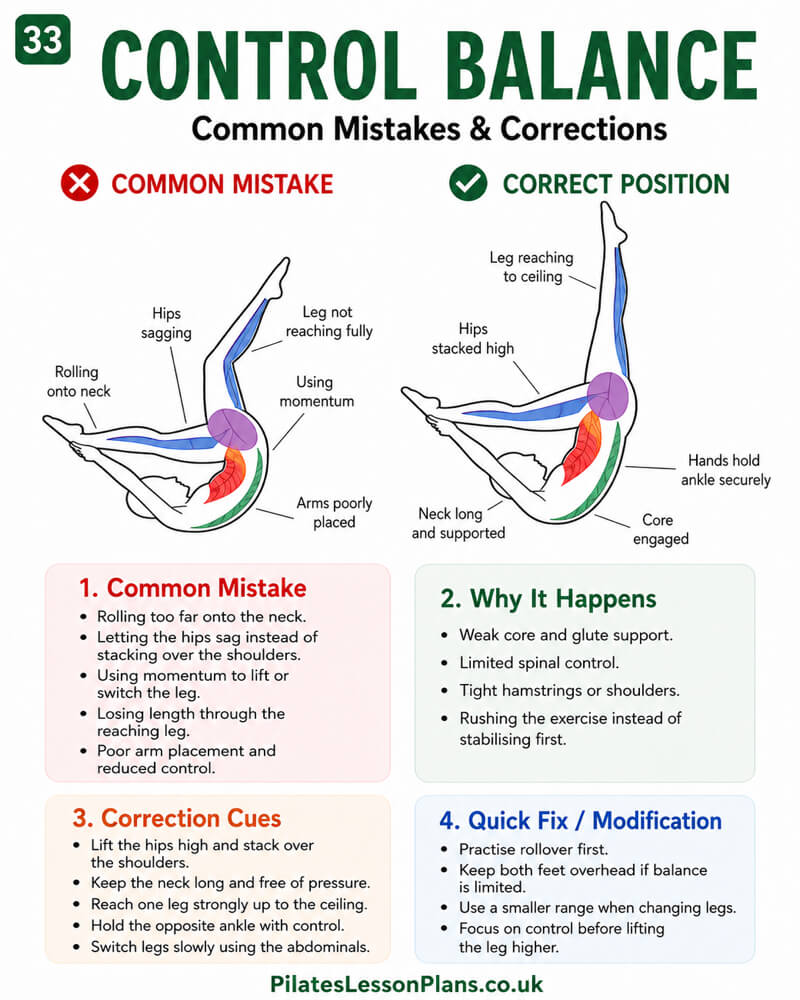
Control Balance Pilates Common Mistakes & Corrections Card.
Common Mistake
In Control Balance, students often collapse into the neck, pull the leg aggressively, lose pelvic lift, or rush the leg change. The exercise should be controlled balance, not “please send help, my leg is in the air”.
Why It Happens
This usually happens when the student lacks the shoulder support, abdominal control, hamstring length, or inverted balance needed to maintain the shape while changing legs.
Correction Cues
Cue the weight into the shoulders and upper back, the neck to stay long, the pelvis to stay lifted, and the legs to reach in opposition. The hand holds lightly; it does not yank the leg into submission.
Quick Fix / Modification
Practise Roll Over, Scissors, or smaller inverted leg changes first. Keep the movement slow and avoid the full version if the student cannot keep weight away from the neck.
Get the Pilates Common Mistakes & Corrections Card Deck here.
34. Push Up
Pilates Common Mistake & Correction Card
Click the image to enlarge it
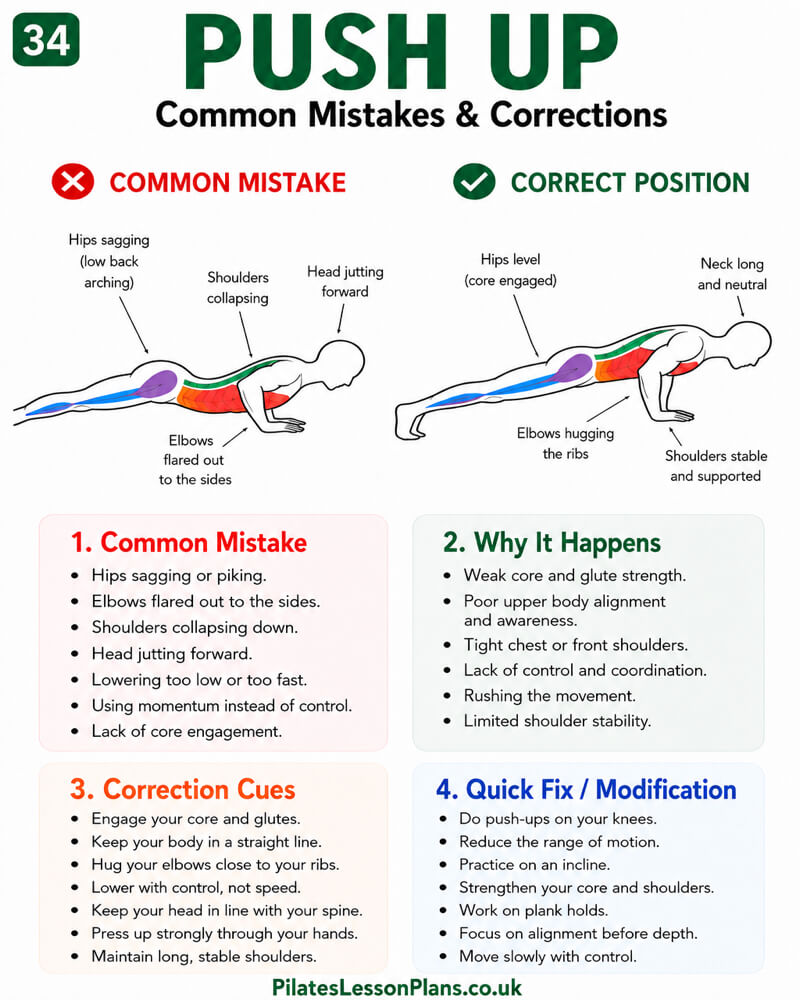
Push Up Pilates Common Mistakes & Corrections Card.
Common Mistake
In Push Up, students often drop the hips, round the shoulders, poke the head forward, flare the ribs, or collapse through the arms. The plank line disappears, and the exercise becomes a negotiation between the floor and the upper body.
Why It Happens
This usually happens when the student lacks enough shoulder stability, core support, arm strength, or plank alignment to control the full movement. The body then borrows from the neck, lower back, or shoulders.
Correction Cues
Cue the body into one long line from head to heels, press the floor away, keep the ribs supported, and bend the elbows with control. The head and neck should stay aligned with the spine.
Quick Fix / Modification
Lower the knees, reduce the range, practise plank holds, or use an incline with hands on a raised surface. Build the line first, then add the push. The floor will still be there later.
Get the full Pilates Common Mistakes & Corrections Card Deck here.
FAQs
What is this free Pilates Common Mistakes & Corrections guide?
This is a free visual guide to common mistakes in the 34 classical Pilates mat exercises. Each exercise includes a card image, a common mistake, why it happens, correction cues, and a quick fix or modification.
Who is this guide for?
It’s designed for Pilates teachers, trainee Pilates teachers, teacher trainers, and serious students who want to understand technique, spot common errors, and cue corrections more confidently.
What exercises are included?
The guide covers all 34 classical Pilates mat exercises, including The Hundred, Roll Up, Roll Over, One Leg Circle, Rolling Back, One Leg Stretch, Double Leg Stretch, Spine Stretch, Rocker With Open Legs, Cork Screw, Saw, Swan Dive, One Leg Kick, Double Leg Kick, Neck Pull, Scissors, Bicycle, Shoulder Bridge, Spine Twist, Jack Knife, Side Kick, Teaser, Hip Twist, Swimming, Leg Pull Front, Leg Pull, Side Kick Kneeling, Side Bend, Boomerang, Seal, Crab, Rocking, Control Balance, and Push Up.
Can I use this guide when teaching Pilates classes?
Yes. Use it as a teaching reference when planning classes, revising correction cues, preparing teacher training material, or checking the most common technique issues in each classical mat exercise.
What’s the difference between this free guide and the paid card deck?
This free guide gives you the full blog-post version. The paid Pilates Common Mistakes & Corrections Card Deck gives you the cards in a much more practical format: an interactive app-like PDF, a printable PDF, and individual JPG and PNG files.
Can I print the cards?
The card images in this blog post are useful for online viewing, but the paid deck is the best option for printing. It includes a high-quality printable PDF, so you can print the cards as flashcards, studio charts, teacher training handouts, or wall posters.
Can I view the cards on my phone or tablet?
Yes. The Pilates Common Mistakes & Corrections Card Deck includes an interactive app-like PDF, so you can browse the cards on your desktop, laptop, phone, iPad, or tablet. Perfect for those moments when you’re planning a class and your brain says, “What exactly was that Jack Knife correction again?”
Do these cards replace Pilates teacher training?
No. They are a visual study and teaching support tool, not a replacement for proper Pilates teacher training, professional judgement, or individual assessment. Think of them as a practical correction companion, not a tiny laminated qualification.
Are these suitable for beginners?
Some of the exercises in the classical Pilates mat sequence are advanced, so beginners should work with suitable modifications and, where possible, guidance from a qualified teacher. The guide is especially useful for understanding what to avoid and how to make exercises safer and more achievable.
Do the cards include anatomy?
These cards focus mainly on common mistakes, correction cues, and quick fixes. If you want the anatomy-focused version, you may also enjoy my Pilates Anatomy Card Deck and Pilates Anatomy Course.
Want the full Pilates Common Mistakes & Corrections Card Deck?
Pilates Common Mistakes & Corrections Card Deck
If this free guide has been useful, the full deck gives you all 34 correction cards in a much easier-to-use format: interactive app-like PDF, printable PDF, plus JPG and PNG files.
Use them for lesson planning, teacher training, class preparation, studio charts, quick correction reminders, or those moments when a Teaser starts looking like a small Pilates emergency.
Related Pilates Resources
If you enjoyed this guide, you may also like these Pilates teaching resources:
-
Pilates Common Mistakes & Corrections Card Deck — the full printable and interactive version of these 34 correction cards.
-
Pilates Anatomy Card Deck — visual anatomy cards for the 34 classical Pilates mat exercises.
-
Pilates Anatomy Course — a hand-drawn doodle notebook for understanding Pilates anatomy in a friendly, visual way.
-
Joseph Pilates Mat Card Deck — cards for the classical Pilates mat exercise sequence.
-
Joseph Pilates Infographics Card Deck — visual infographic cards for the classical Pilates mat exercises.
-
Online Pilates Lesson Planner — plan Pilates classes faster with ready-made Pilates lesson plans, exercises, and teaching tools.
George’s Conclusion

Spotting Pilates mistakes is not about being picky, perfectionist, or standing at the front of class with a clipboard and a suspicious eyebrow.
It’s about seeing patterns clearly, understanding why they happen, and helping students find a safer, stronger, more organised version of the exercise.
Sometimes the correction is tiny: lift the legs higher, soften the ribs, press the arms down, keep the pelvis still, support the neck, slow the tempo, or make the movement smaller.
Tiny corrections can make a big difference.
And if this guide helps you spot one wobbly pelvis, one overexcited neck, or one Jack Knife that has gone a little rogue, then my work here is done.
Get the full Pilates Common Mistakes & Corrections Card Deck here.


George Watts
Latest posts by George Watts (see all)
- Pilates Common Mistakes: Free 34 Exercise Correction Guide - July 6, 2026
- Pistol Squat With Resistant Band + 30 Pilates Exercise Cards - June 21, 2026
- Leg Extension With Straight Leg Band + 30 Pilates Exercise Cards - June 21, 2026