
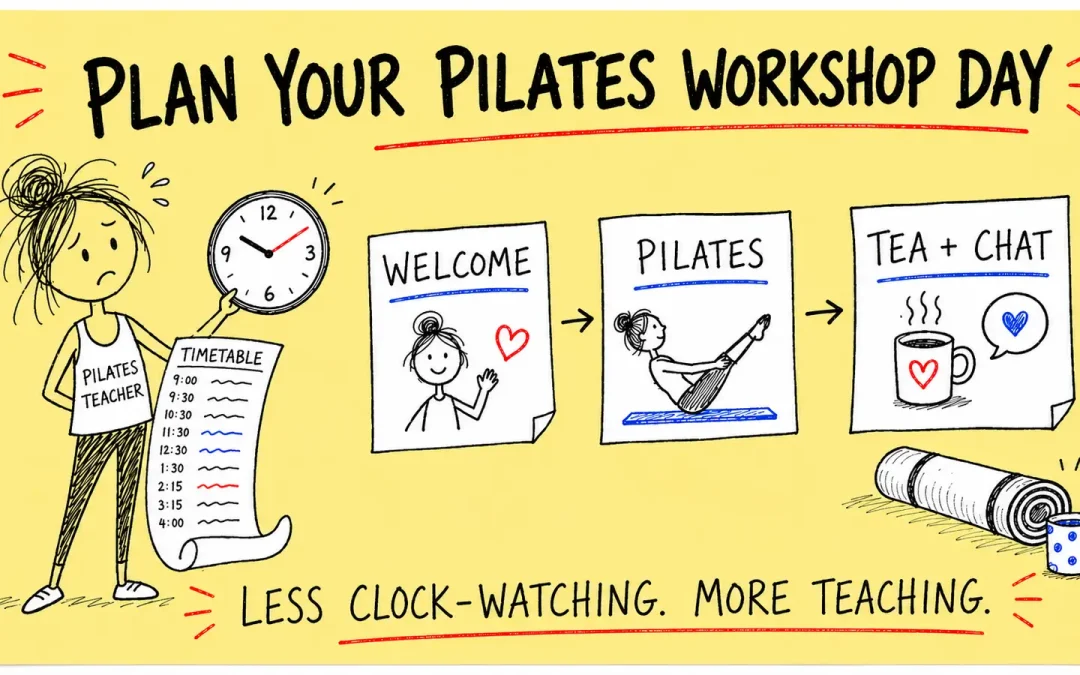
A Pilates workshop can be a lovely day of movement, learning and community. It can also become seven hours of timetable Tetris if the planning is left until Thursday night.
This guide gives you a practical way to organise the day without squeezing every useful idea into the same heroic 20-minute slot.
You can also download my new five-page editable Pilates Workshop Day Itinerary Template. It includes a full-day timetable, session planner, equipment and attendee checklists, contingency planning and post-workshop follow-up.

From George’s Pilates Marketing Diary
A workshop needs a clear promise, a sensible route through the day and enough spare time for questions. “We’ll cover everything” is not a workshop objective. It is a cry for help wearing a lanyard.
Free Editable Pilates Workshop Day Itinerary Template
The old download linked from this post is no longer available. I have replaced it with a more useful Word template that you can edit, duplicate and reuse for future workshops.
What is included
- Workshop details, outcomes and preparation checklist.
- Editable full-day itinerary with example timings.
- Reusable session-planning page.
- Equipment, attendee communication and contact checklists.
- A practical Plan B and end-of-day review.
Download The Free Editable Word Template
Microsoft Word document · 5 editable pages
12 Tips For Planning A Successful Pilates Workshop
Use this overview to jump to the part of workshop planning currently staring at you from the to-do list.
- Decide the workshop’s one main outcome
- Know exactly who is attending
- Choose a theme with a clear boundary
- Build the itinerary backwards
- Create a separate plan for each practical session
- Plan transitions as carefully as exercises
- Match the equipment to the room
- Prepare options, not three different workshops
- Promote early and clearly
- Send practical information before the day
- Make the teaching materials easy to recognise
- Plan the follow-up before the workshop
1. Decide The Workshop’s One Main Outcome
Start with the sentence: “By the end of this workshop, participants will be able to…”
A precise outcome helps you decide what belongs in the day and, just as importantly, what can wait for another workshop. “Improve understanding of neutral pelvis during matwork” gives you something to teach and assess. “Explore Pilates” gives you a large open field and no obvious gate.
2. Know Exactly Who Is Attending
Ask about experience, relevant needs and expectations before finalising the sessions. A room of newly qualified teachers requires a different balance of explanation and practice from a mixed public group.
Use the information to shape your pace, terminology and exercise choices. It should guide the workshop without encouraging you to diagnose or promise individual outcomes.
3. Choose A Theme With A Clear Boundary
Useful themes include core control, posture and alignment, small-equipment ideas, classical matwork or programming for beginners. A good theme creates a thread between sessions.
Keep the boundary visible. A posture workshop does not also need to become an anatomy lecture, a marketing seminar and a surprise foam-roller festival.
4. Build The Itinerary Backwards
Fix the arrival time, lunch, breaks and finish first. Then place the teaching sessions between them. This stops practical sessions quietly expanding until lunch becomes a banana eaten beside the reformer.
Allow time for questions, equipment changes and returning from breaks. If the venue has a firm closing time, work backwards from the moment the room must be empty—not merely when you intend to say goodbye.
5. Create A Separate Plan For Each Practical Session
Give each practical session its own aim, sequence, teaching focus, modifications and timing. Separate plans are easier to teach from and simpler to adjust when the morning runs ten minutes late.
You can build and save the sessions in the Online Pilates Lesson Planner. If you prefer arranging ideas physically before building the final plan, the Joseph Pilates Mat Card Deck, Pilates Matwork Card Deck and Pilates Reformer Card Deck can help you see and rearrange a sequence.
6. Plan Transitions As Carefully As Exercises
Write down what happens between activities. Who moves the equipment? Where will bags and shoes go? Does a discussion happen on mats, chairs or standing around while everyone politely waits for a chair to appear?
Good transitions protect the flow of the day and reduce the temptation to rush the next session.
7. Match The Equipment To The Room
Count what the venue actually has and confirm what condition it is in. If participants rotate between stations, decide the group sizes and route in advance.
For venue checks, use my guide to finding and assessing a Pilates class venue. Take spare small equipment when practical, but avoid bringing the entire prop cupboard in case a resistance band experiences an identity crisis.
8. Prepare Options, Not Three Different Workshops
For key activities, prepare a simpler option, the intended version and a suitable progression. Add a substitute for anything that depends on a particular piece of equipment.
You do not need a completely different timetable for every possible participant. You need clear teaching decisions and permission to adapt the plan in front of you.
9. Promote Early And Clearly
Begin promotion around six weeks ahead when possible. Explain who the workshop is for, what participants will learn, what experience they need and what is included in the price.
An early-booking price can help, but clarity is more persuasive than decorative urgency. If you need promotional artwork, adapt one of my Pilates flyer templates.
10. Send Practical Information Before The Day
Send directions, parking information, arrival time, clothing guidance, what to bring, food arrangements and any relevant venue details. Tell people what happens if they arrive late.
A useful reminder email answers the questions people tend to remember while driving towards the venue.
11. Make The Teaching Materials Easy To Recognise
Use consistent headings, colours and exercise illustrations across the timetable, handouts and follow-up resources. This makes the material easier to navigate and helps it feel like one coherent workshop.
My Pilates Stick Figure Kit can be used in handouts and promotional materials, while the complete Pilates Exercise Card Deck collection provides ready-made visual teaching aids.
12. Plan The Follow-Up Before The Workshop
Prepare the thank-you email, resource links and feedback questions before the day. You will be less enthusiastic about writing them after packing mats, answering final questions and discovering the venue’s back door has its own locking philosophy.
Record what worked, what participants asked for and what you would change. Those notes make the next workshop faster to plan and usually reveal the subject people want next.
George’s Conclusion
A successful workshop is not the one with the fullest timetable. It is the one with a clear purpose, enough space to teach well and participants who leave knowing what they learned.
Use the editable template to get the whole day out of your head and onto the page. Then build the practical sessions separately, check the transitions and keep one calm Plan B nearby.
The timetable may still develop opinions, but at least they will be written down.


George Watts
Latest posts by George Watts (see all)
- Pilates Referrals and Reviews: How to Ask Without Feeling Awkward - August 30, 2026
- Google Business Profile for Pilates Teachers: Free Local SEO Checklist - August 30, 2026
- Pilates Class Pricing Calculator: How Much Should You Charge? - August 30, 2026