

Starting a Pilates business does not require a glossy studio, a complicated website and 47 matching water bottles.
It requires a useful offer, a realistic grasp of the numbers and enough courage to invite the first few people through the door.
“What do I actually need to do first?”
That is the question this guide answers.
The six steps below give you the practical overview. If you need the deeper planning work, use my Pilates Business Plan Guide alongside the free workbook.
Download the free Pilates Business Starter Workbook
Choose Your Workbook
Download The LibreOffice Workbook
Nine editable tabs · Automatic revenue, profit and margin calculations
Step 1: Choose the business you are actually starting
Begin with the smallest honest version of the business.
You might teach one weekly class in a hired hall, offer private sessions from a shared studio or build a mixture of in-person and online teaching.
Write down the delivery model, location, weekly teaching limit and income goal. This stops a simple teaching business quietly turning into a plan for a wellness empire before you have found your first student.
Choose an appropriate business structure
In the UK, many independent teachers begin as sole traders, while some choose a limited company or partnership.
The right option depends on your circumstances, tax position, responsibilities and longer-term plans. Check the current GOV.UK business structure guidance and speak to an accountant if you are uncertain.
Do not copy another teacher’s structure simply because it appears to work for them.
Step 2: Decide who you most want to help
A class for everybody is difficult to explain to anybody.
Choose a useful starting audience, such as complete beginners, active older adults, busy office workers, runners or people who prefer small and supportive classes.
“Who do I enjoy teaching, and what result are they hoping to achieve?”
Your answer shapes the class, venue, timetable, price and marketing message.
It also leads naturally to your positioning. The 10 Pilates Business USP Tactics will help you explain why a suitable student should choose your class.
Step 3: Write a lean Pilates business plan
Your first business plan can be short.
You need a clear description of the business, the students you want to serve, the services you will offer, how people will find you and what the numbers need to look like.
A useful plan should help you make decisions. It does not need to impress an imaginary boardroom full of people stroking their chins.
Use the complete Pilates Business Plan Guide when you are ready to work through each section.
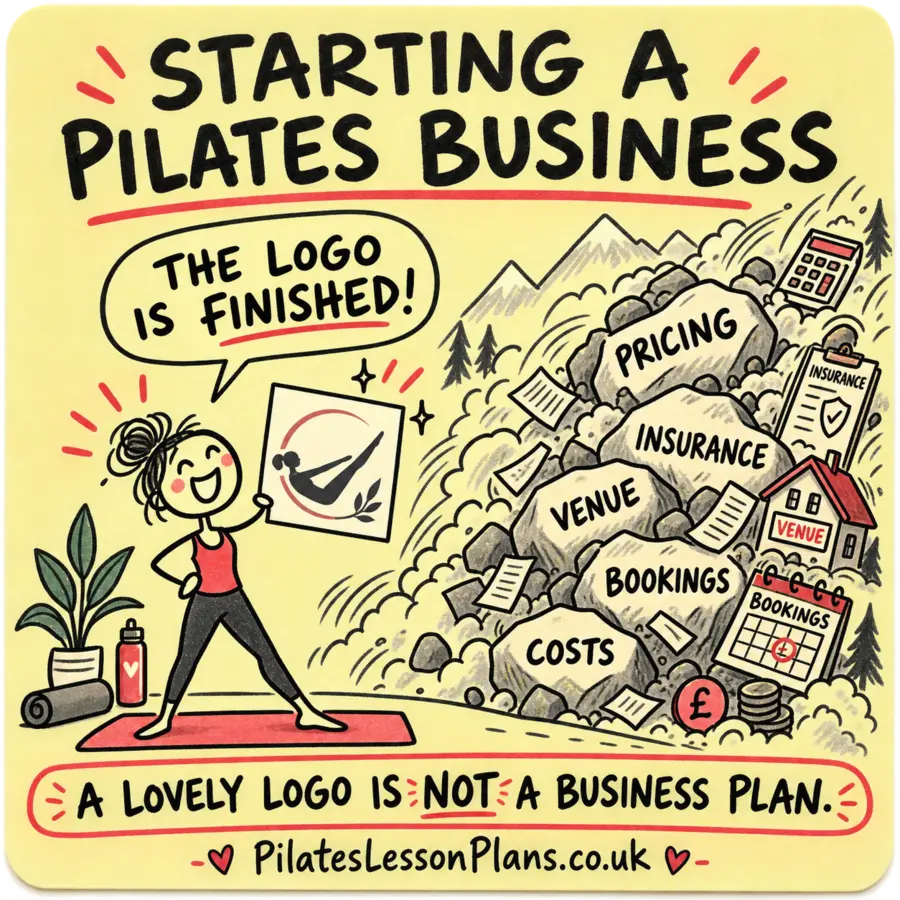
Step 4: Test your prices and costs
A busy class is not automatically a profitable class.
List your expected income alongside venue hire, insurance, software, payment fees, equipment, marketing, professional development and preparation time.
For every service, estimate:
- the maximum number of students;
- the realistic average attendance;
- the price per student or session;
- the number of sessions each month;
- the hours spent teaching, planning and administering it.
Use realistic attendance rather than assuming every mat will always contain a smiling human.
The Services & Pricing and Monthly Forecast tabs in the workbook calculate revenue, teaching hours, costs and operating profit.
Step 5: Put the practical protections in place
Good administration protects both you and your students.
Confirm that your qualifications and experience match the people and sessions you intend to teach. Arrange insurance that covers your delivery model, venues and audience.
CIMSPA highlights public liability and professional indemnity as important cover for self-employed sport and physical activity professionals. If you employ people, separate Employers’ Liability requirements may apply.
You should also prepare suitable participant screening, emergency procedures, attendance records, cancellation terms and a safe way to store personal information.
If you send marketing emails or texts, check the ICO’s current direct-marketing guidance.
This article is a planning guide, not legal, tax or insurance advice. Check the rules that apply to your circumstances.
Step 6: Launch small, learn and improve
Your first version is allowed to be small.
One class gives you real information about the venue, timetable, price, student questions and whether you enjoy teaching that audience.
Choose a 90-day goal and turn it into weekly actions. Useful early actions might include speaking to ten potential students, comparing three venues, testing one class description and inviting people to a first block.
“What is the smallest useful action I can complete this week?”
That question is usually more valuable than asking how to build the perfect business.
George’s Conclusion

A successful Pilates business is built through useful classes and repeated small decisions.
Choose a clear audience, understand the numbers, protect the practical foundations and give yourself permission to improve as you go.
The free Pilates Business Starter Workbook will help you put those decisions on paper.
When the business starts getting busier, the Online Pilates Lesson Planner can reduce the time spent creating and organising classes.
Current UK guidance used for this update


George Watts
Latest posts by George Watts (see all)
- Pilates Referrals and Reviews: How to Ask Without Feeling Awkward - August 30, 2026
- Google Business Profile for Pilates Teachers: Free Local SEO Checklist - August 30, 2026
- Pilates Class Pricing Calculator: How Much Should You Charge? - August 30, 2026