
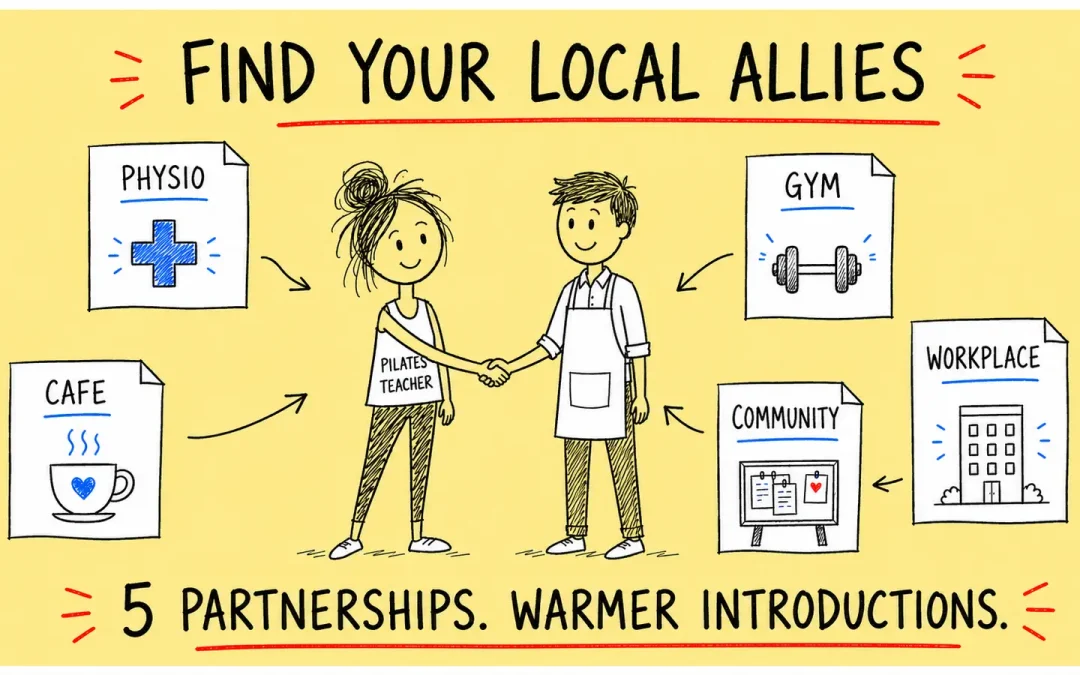
5 Local Partnership Marketing Ideas For Pilates Teachers
FROM GEORGE’S PILATES MARKETING DIARY
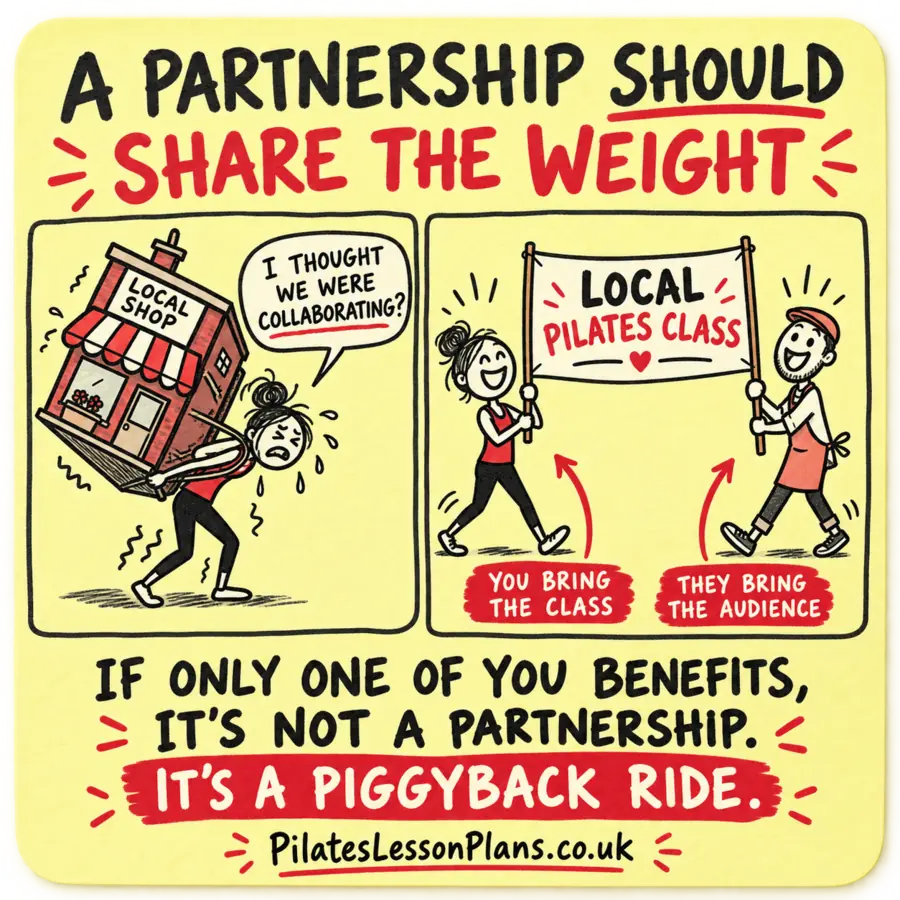
A good partnership is not you doing all the work beside somebody else’s logo.
The useful version is much simpler. You bring a class their customers may value. They bring trusted access to a suitable local audience. Nobody needs to carry a café on their back.
A local Pilates teacher does not always need a larger audience.
Sometimes you need a sensible introduction to the right small audience. A venue, café, workplace or community organisation may already know the people you hope to reach. A thoughtful partnership can connect the two without either business behaving like an overexcited leaflet cannon.
“What can we create together that genuinely helps both audiences?”
Local Partnership Marketing At A Glance
- Choose an audience overlap: not merely another business with a front door.
- Offer mutual value: each partner should gain something useful.
- Keep the first test small: one event, one offer or one month.
- Protect customer information: do not casually exchange email lists.
- Track the result: use a specific link, code or booking question.
What Is “Piggyback” Marketing?
In the original version of this article, piggyback marketing meant finding a business with suitable customers and borrowing some of its reach. The basic idea still has merit, but the language can suggest one person is getting a free ride while the other does the marching.
I prefer local partnership marketing. It asks a healthier question: what can two organisations offer together that is more useful than either could offer alone?
A hairdresser displaying your flyer is not automatically a partnership. It may simply be a kind hairdresser displaying your flyer. A genuine partnership has a shared purpose, agreed responsibilities and a clear benefit for both sides.
Five Practical Pilates Partnership Ideas
- Partner with your venue. Ask the venue to include your class in its timetable, welcome email or community noticeboard. In return, keep your information accurate, promote the venue properly and make booking easy. If you are still searching for a room, use the guide to finding a venue for your Pilates class.
- Create a referral swap with a complementary business. A physiotherapy clinic, independent sports shop or massage therapist may serve people who are interested in suitable movement classes. Keep recommendations honest and within your professional scope. Each business can display approved information or mention the other when genuinely relevant.
- Run a workplace taster. Offer a short, clearly described introductory session for a local employer, then provide an optional route into an ongoing workplace or community class. The employer receives a useful staff activity; you gain a carefully matched introduction. The guide to setting up a Pilates corporate programme will help you plan the practical details.
- Contribute to a local event. A community day, charity event or wellbeing fair may welcome a short demonstration, mini-class or practical talk. Agree the space, equipment, insurance, audience and promotion before promising anything. A vague “we’ll sort it on the day” is how instructors end up teaching beside a bouncy castle and a brass band.
- Run a small joint promotion. You might offer a class place while a partner provides another relevant prize or benefit. Keep the entry method simple, publish clear terms and award the prize as described. Competitions create administration, so only use one when it serves a real purpose rather than because the word “giveaway” briefly made everybody giddy.
How To Choose The Right Partner
The best partner is not necessarily the business with the largest following. A smaller organisation with a trusted local audience and a genuine connection to your class may be far more useful.
Check these five things before approaching anybody:
- Audience fit: are their customers realistically interested in this class?
- Reputation: would you feel comfortable being publicly associated with the business?
- Practical fit: can both sides deliver what is being proposed?
- Equal value: is the exchange fair without requiring identical contributions?
- Clear boundaries: who handles bookings, money, promotion, customer questions and follow-up?
If the offer sounds identical to every other local class, clarify your message first with these Pilates USP tactics.
A Short Partnership Email That Sounds Human
Your first message does not need a seventeen-page proposal or a paragraph announcing your passion. Business owners are very busy people. Some are currently reading emails while standing beside a printer that has decided cyan is a philosophical concept.
Subject: Simple local Pilates partnership idea
Hello [Name],
I teach [type of Pilates class] at [venue/town]. I noticed that we both work with [relevant audience], and I wondered whether a small partnership might be useful.
My idea is: [one-sentence proposal]. I could provide [your contribution], and the benefit for your business or audience would be [specific benefit].
Would you be open to a short conversation next week? If it is not a fit, no problem at all.
Best wishes,
[Your name]
Specific beats dazzling. “Could we test one beginner taster for your staff?” is easier to answer than “Let us synergistically transform the wellbeing landscape of Pembrokeshire.”
Agree The Details Before Anybody Prints 500 Flyers
A one-page agreement or email summary is enough for a small test. Record:
- the offer and intended audience;
- what each partner will provide;
- who approves the wording and images;
- booking, payment and refund responsibilities;
- start and finish dates;
- how results will be measured; and
- what happens after the test.
When you need promotional material, the editable Pilates flyer templates give you six starting designs. Replace every placeholder and make the shared offer obvious.
A Serious Note About Email Lists And Competitions
Do not ask a partner to hand over its customer list, and do not add competition entrants to your marketing list merely because they entered. If a partner promotes your class by email, the safest simple arrangement is usually for that partner to communicate with its own audience under its own rules, while you provide accurate approved copy.
The UK Information Commissioner’s Office explains that electronic marketing rules vary according to the recipient and method, and that personal data used for direct marketing remains subject to data-protection law. Read the current ICO business-to-business marketing guidance before starting an email campaign.
If you run a prize promotion, make significant conditions clear, keep the full terms accessible and award the prize as described. The ASA competition guidance is the practical starting point.
Track A Small Test
Begin with one partner, one offer and one short test period. Give the campaign a unique booking link, referral code or simple booking question such as “Where did you hear about this class?”
Record:
- enquiries;
- trial bookings;
- attendance;
- paid enrolments;
- time and direct cost; and
- whether both partners want to repeat it.
A partnership that produces no bookings may still teach you something useful. A partnership that produces bookings but exhausts everybody is also teaching you something, although it may be expressing itself rather loudly.
The Seven-Point Partnership Check
- Our audiences overlap for a clear reason.
- The offer is useful and accurately described.
- Both partners receive fair value.
- Responsibilities are written down.
- Customer information is handled lawfully.
- The booking route and tracking method work.
- We have agreed when to review or stop the test.
George’s Conclusion

Good local marketing is often less about shouting louder and more about standing beside somebody the audience already trusts.
Choose one sensible partner. Propose one small idea. Make the value clear on both sides and measure what happens. If it works, repeat it. If it does not, thank each other, keep the relationship intact and resist pretending the “brand awareness” was definitely enormous.
For more practical promotion ideas, explore the marketing tactics for newly qualified Pilates teachers, these eight Pilates marketing ideas, or the resources in the Pilates Teacher Marketing Kit.



George Watts
Latest posts by George Watts (see all)
- Pilates Referrals and Reviews: How to Ask Without Feeling Awkward - August 30, 2026
- Google Business Profile for Pilates Teachers: Free Local SEO Checklist - August 30, 2026
- Pilates Class Pricing Calculator: How Much Should You Charge? - August 30, 2026