
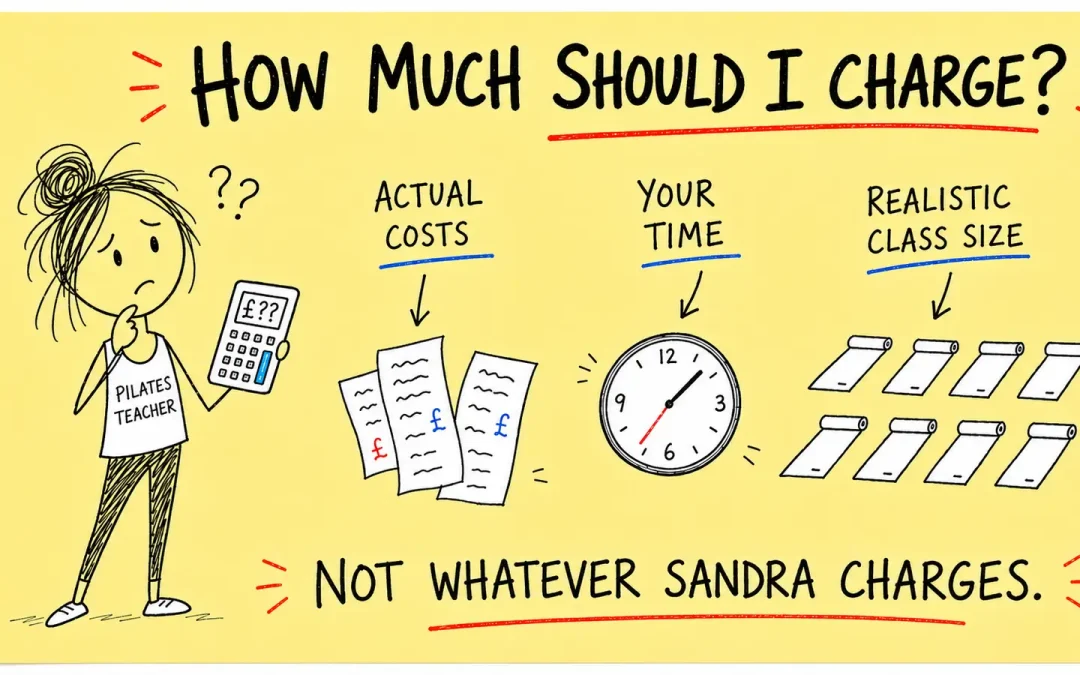
How much should you charge for a Pilates class?
There is a traditional method used by many new Pilates teachers.
You look at what three nearby teachers charge, become mildly confused, choose the middle number and hope nobody asks how you arrived at it. It is not a pricing strategy so much as financial pin-the-tail-on-the-donkey.
Your class price needs to reflect your costs, your working time and your realistic attendance—and the fact that a business occasionally needs to make a profit. That is why I created the free Pilates Class Pricing Calculator.

From George’s Pilates Marketing Diary
If your price was chosen because it “felt about right”, do not panic. Many small businesses begin with a number that wandered in from somewhere and made itself comfortable. The useful bit is checking it before it starts ordering matching cushions.
Why copying another Pilates teacher’s price does not work
Another teacher might charge £10, £12 or £15 per class.
That is useful market information, but it does not tell you what you need to charge. She might own her studio.
You might pay £35 every time you unlock the village hall. She might teach twenty students.
You might deliberately keep your class to eight because you enjoy knowing everybody’s name and noticing when Derek’s left shoulder has quietly migrated towards his ear. She might live two minutes from the venue.
You might spend forty minutes travelling there, fifteen minutes arranging mats and another twenty minutes replying to messages asking, “Is Pilates the one with the machines?”

Competitor prices matter, but they are only one part of the decision. Business Wales advises considering the cost of providing the service, the market, competitors and the value offered.
Its guidance also explains that the first step in pricing is understanding your costs and ensuring the price can cover them while making a profit.
The four figures behind a sensible Pilates class price
Four numbers do most of the work.
1. Your cash costs
Start with the costs connected with running one class:
- Venue hire
- Travel and parking
- Equipment, cleaning and consumables
- Booking and payment fees
- Marketing and administration
- Any other direct class costs
Do not leave out small costs simply because they look harmless on their own. Small costs have a habit of forming a committee.
If venue costs are making the figures uncomfortable, use my guide to finding a suitable Pilates class venue.
2. All your working time
A one-hour Pilates class rarely requires only one hour of work.
You prepare the session, travel, open the venue, arrange equipment, welcome students, teach, pack everything away, take payments and answer messages. The calculator asks for your teaching time and your additional preparation, travel and administration time.
This is important because unpaid work is still work. It does not become leisure merely because you completed it while drinking tea.
You can reduce some preparation time with the Online Pilates Lesson Planner, but the time you genuinely spend running the class should still be recognised.
3. Your target hourly pay
Choose what you want to earn for each hour you work, including the invisible hours around the class.
This is not the same as the amount left in the booking account after teaching. Your target hourly pay is compensation for your time.
Venue hire and other class costs must be covered separately. Think of it this way: if you would not cheerfully work for £8 an hour in somebody else’s business, your own business should not be allowed to sneak that arrangement past you while wearing leggings.
4. Your realistic number of paying students
Use the average number of students you genuinely expect, not the maximum number of mats you can squeeze into the room.
A room might hold twelve people. If your average attendance is eight, calculate the price using eight.
Pricing around twelve imaginary students produces very encouraging figures and rather less encouraging bank statements. If you need help attracting suitable local students, see Pilates marketing for new teachers and these eight Pilates marketing tactics.
What the calculator does
The calculator adds together your cash costs and the pay you want for all your working time.
It then adds a small profit buffer and divides the required class revenue by your expected number of paying students. Finally, it rounds the result up to the nearest 50p so you receive a usable class price instead of something like £13.6125.
Students tend to become suspicious when asked to bring four decimal places. The formula is intentionally simple: Cash costs + pay for your time + profit buffer ÷ expected students = suggested price per student. This is a starting point, not a commandment engraved on a Reformer.
You should also consider your local market, your experience, the type of class, the value you provide and how your offer differs from alternatives. My guide to ten Pilates USP tactics can help you explain that value without resorting to “friendly classes for all abilities”, which is lovely but also written on approximately every fitness flyer since 1987.
Download the free Pilates Class Pricing Calculator
Choose the version that suits the software you use.
Choose Your Calculator
Both versions contain the same calculator and example figures.
Replace the pale-yellow figures with your own and the suggested price updates automatically.
Download The LibreOffice Calculator
One editable worksheet · Automatic suggested price
A quick pricing example
Imagine a teacher has the following figures:
- £39 in cash costs
- Two hours of total working time
- A target pay rate of £30 per hour
- Eight expected students
- A 10% profit buffer
The class needs to generate £108.90. Divided by eight students, that produces £13.61 per student.
The calculator rounds the suggested price up to £14 per student. That does not automatically mean £14 is the perfect market price.
It means the teacher now has a properly calculated starting point and can make an informed decision.
Three final checks before changing your price
Run these three checks before changing what students pay.
- Check the local market. Compare similar classes, but do not blindly copy them.
- Check the value of your offer. Experience, specialist knowledge, individual attention and a well-structured class all affect value.
- Check the numbers regularly. Venue hire, payment fees and attendance change. Review the calculator whenever something material changes.
If you are still building the foundations of your teaching business, work through six steps for setting up a successful Pilates business and the Pilates business plan guide.
George’s Conclusion
A sensible class price is not the highest number you can persuade people to pay.
It is a price that covers the real cost of teaching, values your working time and still feels fair to the students in front of you.
Use the calculator as your starting point, compare the result with your local market and review it when your costs or attendance change.
Sandra may still have opinions. Happily, she is not in charge of your spreadsheet.

The following two tabs change content below.


George Watts
Pilates Teacher
Hi, I’m George—a Pilates teacher from West Wales, lifelong movement enthusiast and creator of free Pilates lesson plans. I make practical tools for instructors who would rather spend less time wrestling with lesson plans and more time teaching people. Start with my Online Pilates Lesson Planner for quick, editable class plans, or browse the Pilates Card Decks when your teaching cupboard could use a few fresh ideas.
Latest posts by George Watts (see all)
- Pilates Referrals and Reviews: How to Ask Without Feeling Awkward - August 30, 2026
- Google Business Profile for Pilates Teachers: Free Local SEO Checklist - August 30, 2026
- Pilates Class Pricing Calculator: How Much Should You Charge? - August 30, 2026