
Free 45-Minute Intermediate Pilates Reformer Workout Plan: Long, Short & Stream Versions
Some Reformer carriages return with control. Others seem to have plans of their own.
FROM GEORGE’S PILATES TEACHING DIARY
Confession: this lesson plan was so easy to create that I felt slightly guilty.
Surely a proper 45-minute Reformer plan should require a desk covered in paper, three abandoned cups of tea and at least one moment of staring into the middle distance.
Instead, I opened the Online Pilates Lesson Planner, copied a shared member plan, moved a few exercises around and edited it until it suited the class. The plan was finished before my tea had even developed that sad little skin on top. I considered pretending it had taken all morning.
I then sipped at my tea, and looked at a blue tit nibbling a nut on the bird feeder, and downloaded the long, short and Stream versions.
Then, to appease the lingering guilt for not having toiled for hours creating the lesson plan, I opened up my Pilates teacher diary and wrote my thoughts about that plan, which you can read below (e.g. if you’ve suddenly got a gaping space in your schedule due to having just created a Pilates lesson plan, within a few clicks, using the Online Pilates Lesson Planner).
“The Online Pilates Lesson Planner does the formatting. I get to do the teaching.”
Below is a 36-exercise intermediate reformer workout that travels from steady footwork to bridges, straps, upper-body strength, kneeling work and some very welcome final stretches.
It builds full-body strength, stability and flexibility while encouraging the sort of smooth, controlled movement that makes a Reformer class look beautifully calm…even when every abdominal muscle involved is quietly filing a complaint.
The Reformer Workout Plan At A Glance
| Class Detail | What’s Included |
|---|---|
| Duration | Approximately 45 minutes |
| Level | Intermediate, with sensible modifications |
| Exercises | 36 exercises and progressions |
| Main focus | Strength, stability, flexibility and controlled flow |
| Equipment | Pilates Reformer; optional small ball |
| Formats | Long teacher plan, short practice sheet and Stream plan |
The Route Through The Workout Plan
- Footwork: Wake up the feet and establish alignment before the carriage gets any ambitious ideas.
- Bridges: Progress from pelvic tilts to single-leg and circular bridge variations.
- Mid-back and arms: Ask the abdominals to keep everything organised while the arms draw I, Y and T shapes.
- Core and legs: Use raises, presses and circles to challenge control without appointing momentum as class captain.
- Upper body: Add extensions, curls, roll-ups and kneeling strength work.
- Mobility and stretches: Finish with Pigeon, Butterfly, Monkey, Scooter and Hamstring stretches, the point at which everybody starts being friends with me again.
Throughout the class, I would favour precision over size, connect each transition through the core and keep reminding everyone to breathe. A smaller movement performed with control is usually more useful than an enormous one powered by momentum. And holding your breath may feel heroic for about three seconds, but it rarely improves a Pilates class.
“Move with precision. Connect each transition through the core. And keep breathing.”
Download My “Free” Reformer Workout Plan In Short & Long Formats…And Access The Streamed Plan With A URL
One plan created with the Online Pilates Lesson Planner becomes three useful formats. There is no need to copy the same exercises into three separate documents, wrestle with columns late at night or discover that exercise number 24 has quietly wandered onto a page of its own.
1) Pilates Teacher Version
45-Minute Intermediate Pilates Reformer Workout Plan (teacher version)
The long version includes detailed teaching directions, benefits, modifications and precautions. It is the version I would use while preparing the class, preferably before students arrive and begin asking cheerful questions while I am still counting springs.
2) Student Practice Sheet
45-Minute Intermediate Pilates Reformer Workout Plan (short version)
The short version gives you a compact visual overview of the entire workout. It is useful for taking into class, sharing with students or rescuing the teacher whose mind has suddenly gone blank after exercise number seventeen.
3) Stream Version
45-Minute Intermediate Pilates Reformer Workout Plan (stream version)
The Stream version shows the exercises individually and in order, giving students a simple way to follow the plan online.
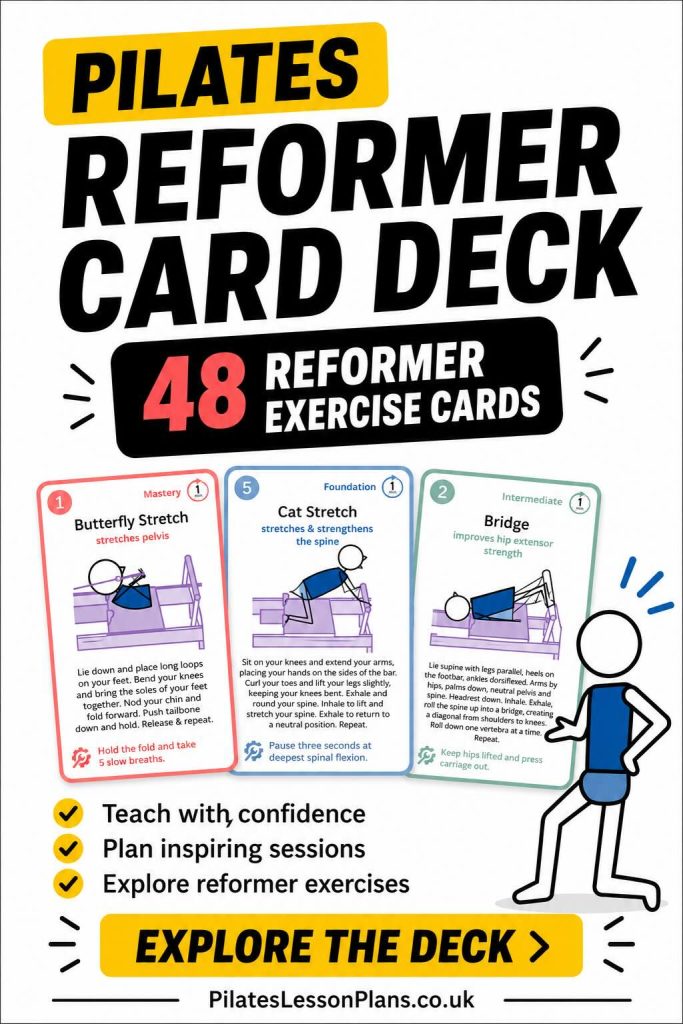
If this plan gives you fresh ideas for your next class, take a look at my Pilates Reformer Card Deck. It is another quick visual way to choose exercises and vary a session, like keeping a box of teaching ideas on the desk, except the cards never interrupt to ask which spring they need.
My Pilates Teaching Diary For This Plan
Footwork and the Runaway-Carriage Test
The class begins with Footwork Heels Parallel, Bird on Perch, Balls of Feet High Heels, Double Heel Lift and Running.
I think of this opening as the Reformer’s polite introductory conversation: nothing too dramatic, but it tells me a great deal. I can observe the feet, knee tracking, pelvic position and whether the carriage returns with control or arrives home like a shopping trolley rolling downhill.
This is the moment to make small corrections. A well-organised footwork sequence lays down the railway tracks for the rest of the class. If the tracks are crooked, the faster train later in the workout is unlikely to improve matters.
The Bridge Family Arrives
Pelvic Tilt leads into Bridge, Bridge Leg Up and Bridge Circle.
I like this progression because each exercise asks a slightly more difficult question…
“Can the student articulate the spine?”
“Can the pelvis remain level?”
“Can one leg move without the rest of the body behaving as though somebody has shaken the table?”
A small ball can provide useful feedback, but it should be a helpful assistant rather than the star of the show.
If the basic bridge becomes untidy, I simply return to the earlier version. Pilates progression is not a staircase that must be climbed at all costs; sometimes the cleverest move is to step back onto the secure stair.
Arms Draw the Alphabet While the Core Keeps the Peace
Hundreds turns up next and announces that the warm-up is officially over.
From there, the I, Y and T arm positions, Arm Circles and Tricep Extensions ask the trunk to remain steady while the arms travel independently.
The body is essentially running a small committee meeting: the shoulders want freedom, the ribs want to join in, and the abdominals must gently remind everybody of the agenda.
I would rather see a smaller arm movement with quiet ribs than a magnificent sweep accompanied by the entire torso. The Reformer is very honest. It has no interest in our artistic interpretation of stability.
Legs In Straps and the Temptation of Momentum
Leg Raises, Pilates V Raises, Inverted V Raises and Parallel Leg Press change the challenge through several leg positions.
Diamond Leg Raises and Leg Circles add variety before Butterfly Stretch and Reclining Pigeon provide a mobility pause.
Leg Circles are particularly revealing. Left unattended, they can grow from neat saucers into satellite dishes. I encourage a range that the pelvis can genuinely control. The goal is not to draw the largest circle in the studio; there is no prize, rosette or ceremonial biscuit for doing so.
Roll-Ups and Another Conversation With Gravity
Arm Extensions, Tricep Curls and Bicep Curls bring the focus towards upper-body strength.
Rollup Prep and Full Rollup reconnect that arm work to abdominal control, while Bow and Arrow to Press adds rotation and coordination.
The roll-up looks like a simple journey from A to B until gravity appears at the meeting with a detailed list of objections. I use the preparation as information rather than merely a waiting room. If control disappears there, the full version is unlikely to restore it by magic.
Kneeling Work and the Peace Treaty at the End
Kneeling Arm Press, Knee Stretch and Up Stretch create a strong finish before Monkey Stretch, Scooter Stretch and Hamstring Stretch calm things down.
The class has done its hard work, the carriage has behaved itself and everybody can begin negotiating a peace treaty with their hamstrings.
Those stretches are not decorative parsley beside the main course. They give students time to notice how the body feels after the strength work and help the session finish with purpose rather than simply running out of exercises.
Six Side Notes I Scribbled In The Margin
Side Note 1: Make friends with the equipment first
Spring resistance, strap length and footbar positions vary between Reformer models. Check everything before class and select settings for the person in front of you. A spring chart can guide the conversation, but it cannot see the student, and, to be fair, it has never met them.
Side Note 2: Use footwork as your detective scene
Foot placement, knee tracking, pelvic position and carriage control all leave clues. I would rather notice them during the opening minutes than meet the same pattern later when the exercise is faster, heavier or balanced on one leg.
Side Note 3: Let the bridges earn their progression
A controlled basic bridge comes before the single-leg and circular variations. If the pelvis begins listing like a small boat in rough water, return to the version where the student can organise the movement and breathe comfortably.
Side Note 4: Choose control over impressive geography
A smaller range performed with good alignment is usually more useful than exploring every available postcode with the legs. This matters particularly during abdominal and strap work, where momentum can quietly borrow the steering wheel.
Side Note 5: Budget time for transitions
This plan contains 36 exercises and progressions. Prepare equipment changes and keep the instructions concise. A transition is part of the lesson, not an awkward corridor everyone must sprint through to reach the next room.
Side Note 6: Teach the student vs fixate on the plan
This is an intermediate plan, not a contract requiring every student to perform every movement. Modify or omit exercises when needed, follow the equipment manufacturer’s guidance and stop any movement that causes pain. The plan works for the teacher; the student does not work for the plan.
George’s Conclusion
 So there you have it: 45 minutes, 36 exercises and no lesson-planning crisis required.
What I like about this plan is the journey…
It begins by organising the feet and legs, gradually asks more of the core and upper body, and then lands softly with mobility work.
It feels like a class with a beginning, middle and end rather than a collection of excellent exercises all trying to speak at once.
Use it exactly as written, shorten it, swap exercises or scribble your own notes all over it.
“A lesson plan should be a useful map, not a stern headteacher standing at the front of the room.”
If your own planning imagination has pressed the snooze button, my Pilates Reformer Card Deck gives you a visual library of exercises for creating fresh classes quickly.
You can also download my Reformer Full-Body Challenge Workout Plan or explore the free Joseph Pilates lesson plan containing all 34 classical mat exercises.
Create Your Next Pilates Plan The Easy Way


George Watts
Latest posts by George Watts (see all)
- Pilates Referrals and Reviews: How to Ask Without Feeling Awkward - August 30, 2026
- Google Business Profile for Pilates Teachers: Free Local SEO Checklist - August 30, 2026
- Pilates Class Pricing Calculator: How Much Should You Charge? - August 30, 2026